A maintenance task is not fully handed over when someone says, “It has been done.” The next operator needs to be able to identify the machine, see what work was expected, understand what was actually completed, and find any issue that still requires action.
That is the purpose of a usable farm equipment maintenance record. It is not simply a signed checklist or a history of repairs. It is a working control for the people who operate, maintain and supervise equipment across shifts, sites or seasons.
A practical record should answer six questions without relying on memory:
- Which item of equipment is involved?
- What task was assigned?
- Who owns the work and who can verify it?
- When is the task due or triggered?
- What evidence shows the result?
- What remains open, restricted or uncertain?
The format may be paper-based, held in a workshop system or managed through a farm operations platform. The medium matters less than whether the record gives the next person enough information to make an appropriate decision.
Start with one equipment-specific maintenance record
Begin with a record for a specific machine or attachment, rather than a general statement such as “tractor service completed.” A general statement may be adequate for a quick verbal update, but it is difficult for another person to check later.
An equipment record should use the identifier your farm already relies on. Depending on the asset, that may include an internal asset number, make, model, registration, serial number, location or hour-meter reading. The WorkSafe New Zealand tractor maintenance record template illustrates this approach with fields for equipment identification, owner or location, and meter reading. It is a tractor-focused example, not a complete record design for every farm machine.
The important distinction is between a procedure and a record.
A standard operating procedure or checklist can tell a team what should be checked. It does not, by itself, show that work occurred on a particular machine at a particular time. FarmHub describes this distinction clearly in its article “From SOP to Proof at Shift Change”: the operating record connects work to a person, time, place, result and evidence.
For example, a procedure might state that a machine must receive a scheduled inspection before a defined operating point. The record should identify:
- the exact machine;
- the scheduled task or inspection;
- the trigger for the task;
- the person assigned to perform it;
- the result recorded for that machine; and
- any fault, exception or follow-up action.
This makes the record useful when equipment changes operators or when a supervisor needs to review work completed during a busy period.
Assign an owner, a verifier and a due point
Maintenance records become unreliable when responsibility is implied instead of stated. “Workshop” or “operator” may describe a group, but it does not identify who should take the next action.
At a minimum, separate three roles:
| Record field | Practical question it answers | Typical responsibility |
|---|---|---|
| Task owner | Who is expected to perform or arrange the work? | Completes the task or raises the need for additional work |
| Verifier | Who can assess whether the recorded result is acceptable under farm procedure? | Checks the evidence, result and any required follow-up |
| Next-action owner | Who takes responsibility if work is incomplete or a defect remains? | Plans, repairs, escalates or reviews the open item |
One person may hold more than one role on a small operation. The point is not to add administration. It is to ensure that responsibility does not disappear between the operator, workshop and manager.
The Kansas State University Extension preventive and corrective maintenance guidance distinguishes between maintenance-team responsibilities, such as scheduled inspections and repairs, and equipment-operator responsibilities during use. Your farm can use that distinction as a starting point, while defining its own roles, authorisations and escalation routes.
The due point should also be explicit. A task may be triggered by:
- a calendar date or operating season;
- engine hours, kilometres or another meter reading;
- a pre-operation check;
- an observed condition, such as a leak or unusual noise;
- a repair work order; or
- a manufacturer-specified service point.
Do not create service intervals from a generic record template. The relevant interval, fluid, part, adjustment or inspection criterion should come from the applicable equipment manual and your farm’s approved procedures. Overseas guidance and generic checklists cannot establish China-specific operating requirements, local safety duties or manufacturer instructions for your machine.
A useful due-point entry is specific enough to trigger action. “Service soon” is difficult to manage. “Review at next scheduled pre-operation check” or “Workshop review before next planned use” gives the team a defined decision point, provided those terms match the farm’s own process.
Record what was done, not only that the box was ticked
A tick can indicate that an item was considered. It does not necessarily explain what was found, changed or left unresolved.
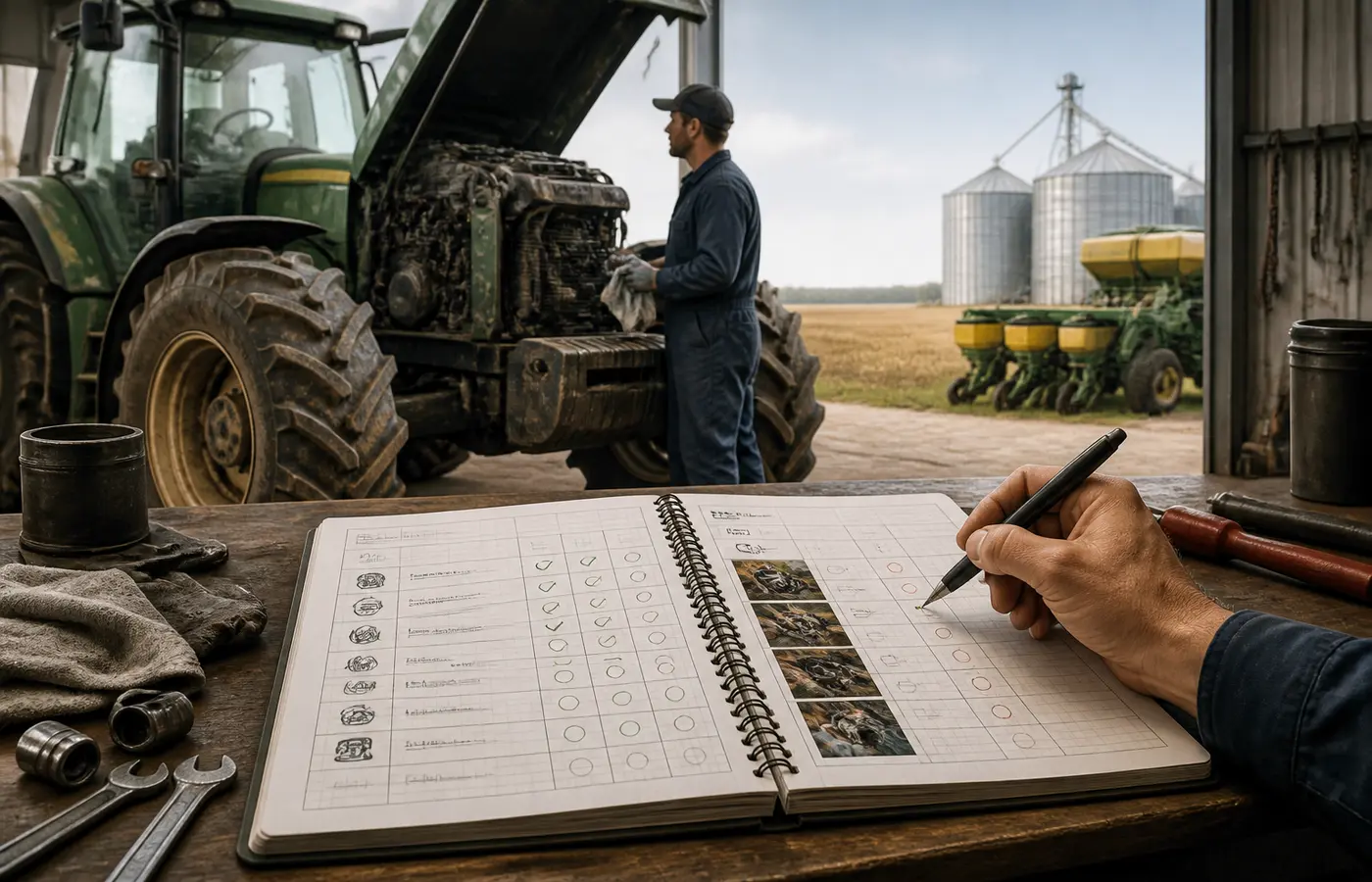
For routine work, the record does not need a long narrative. It does need enough detail for another competent person to understand the result. A concise entry may include the task performed, relevant meter reading, observed condition, corrective action and outcome.
A practical field set could look like this:
| Field | What to record | Why it matters at handover |
|---|---|---|
| Equipment identifier | Asset number and any locally used machine details | Prevents work being attributed to the wrong machine |
| Task and trigger | Scheduled service, pre-operation finding, repair request or inspection | Shows why the work was initiated |
| Date and time | When inspection or work occurred | Places the work in operating sequence |
| Meter reading, where relevant | Hours, distance or other approved measure | Connects the task to the maintenance cycle |
| Work completed | What was inspected, adjusted, replaced or referred | Makes the entry more useful than a bare tick |
| Result | Accepted, requires follow-up, unavailable for verification, or another farm-approved status | Separates completion from outcome |
| Evidence location | Work order number, attached photo, inspection sheet or parts record | Lets the next person find supporting information |
| Open action | Fault, restriction, owner and review point | Keeps incomplete work visible |
The WorkSafe template includes item-level tractor checks and points to the importance of acceptance or rejection considerations. That does not mean every farm asset needs the same fields or checks. A sprayer, irrigation pump, grain-handling unit, trailer or food-handling asset may require different records, competent-person review and manufacturer instructions.
The key operational distinction is this: a task can be completed even when the equipment has not met the required condition.
For example, an operator may complete an inspection and identify a fault. The inspection is complete; the corrective work is not. Marking the entire entry as “complete” without recording the failed condition can mislead the next user. Instead, record the completed inspection, the observed issue, the equipment status under the farm’s procedure, and the person responsible for the next action.
Use completion evidence that the next operator can assess
Evidence should support a decision. It should not become paperwork created only because a form has a blank field.
The right evidence depends on the task and the farm’s management system. It may include:
- a named and dated sign-off;
- a meter reading recorded at the time of work;
- an inspection result against the applicable checklist;
- a maintenance work order number;
- a parts or fluid record where traceability is required by the farm; or
- a photograph where a visible condition, installation or defect needs to be communicated.
A photograph can be useful for showing a visible issue or confirming that a labelled component was changed. It is not automatically proof that a machine is safe, correctly repaired or suitable for use. A sign-off has the same limitation. It records that a person made a statement or assessment; it does not replace the applicable manufacturer instructions, local safety procedure or competent-person judgement.
FarmHub’s handover framework offers a useful test: can the next operator see what was expected, what was observed, what changed, what remains open and who owns the next action? If the answer is no, more evidence may be needed—or the record may simply need clearer wording.
Keep evidence proportionate. A routine, low-complexity check may need only a date, operator name and result. A more significant fault or repair may need a work order, verification record and a clear note of restrictions. The farm should define which records require verification and who is authorised to provide it.
Keep incomplete work and operating restrictions visible
Completed maintenance and unresolved defects should not be stored as if they are the same thing. A record that says “service completed” can conceal a problem if it does not also show that a repair, part, inspection or decision remains outstanding.
Use a separate open-action section or linked corrective-action record. It should state:
- what condition was found;
- when and by whom it was observed;
- whether the equipment has an operating restriction under the farm’s procedure;
- the owner of the corrective action;
- the review or escalation point; and
- where related evidence is held.
Avoid vague notes such as “keep an eye on it.” They place the burden on memory and give no defined owner. A better operational note identifies the condition and the next required decision, without making unsupported claims about safety or compliance.
For example:
Hydraulic leak observed during inspection. Corrective work not recorded as complete. Next-action owner: workshop coordinator. Equipment use status and any restriction to be determined under the farm’s maintenance and safety procedure before next planned use.
This wording does not attempt to decide whether equipment is safe from a generic record alone. Decisions to restrict use, return equipment to service or remove it from service depend on the machine, the fault, manufacturer guidance, local procedures and competent assessment.
The Kansas State guidance notes the role of operators in monitoring equipment while in use and taking steps when a breakdown occurs. In practice, that means operators need a simple route to report conditions, while supervisors and maintenance personnel need a visible way to assign and close the response.
Run a short handover check before the next use
Before equipment is released to another operator or returned to the normal work queue, carry out a brief record review. This is not a substitute for required pre-operation checks. It is a way to ensure that the maintenance status is understandable before the next person relies on the machine.
Use this handover check:
- Confirm the equipment identifier.
- Read the most recent maintenance task and date.
- Check the recorded result and any verification requirement.
- Review outstanding faults, restrictions or unclosed work orders.
- Identify the owner of each next action.
- Locate supporting evidence where the record refers to it.
- Complete the farm’s applicable pre-operation check before use.
The National Safe Tractor and Machinery Operation Program task sheet on preventative maintenance and pre-operation checks describes the general role of daily pre-operation checklists for tractors. It is useful background, but it should not be treated as a universal release-to-use checklist for all farm assets.
A good maintenance record does not promise that every issue has been solved. It makes the current state clear enough that the next operator does not have to guess.
Frequently asked questions
What should a farm equipment maintenance record include?
Include the equipment identifier, assigned task, task owner, trigger or due point, date and time, relevant meter reading, work completed, result, evidence location and any outstanding action. Add fields only where they help the next person assess status or meet your farm’s approved process.
Who should verify that a maintenance task is complete?
The verifier should be the person or role authorised by your farm’s procedure and competent to assess the relevant task and acceptance criteria. The appropriate verifier may differ by equipment type, repair complexity and risk. A generic template cannot determine who is qualified for every situation.
How should a team record an unresolved equipment defect?
Record the observed condition separately from the completed inspection or maintenance task. Name the corrective-action owner, state the next review point, link any work order or supporting evidence, and record any operating restriction only as determined through the applicable farm procedure and competent assessment.
Is a checklist enough to prove maintenance was completed?
Usually, no. A checklist can prompt required steps, but it may not show what occurred on a particular machine, who carried out the work, what was found, whether criteria were met or what remains unresolved. Pair the checklist with an equipment-specific operating record.
The bounded next step is simple: select one frequently used machine, review its current maintenance record, and test whether another operator could identify its latest task, evidence and open issues without asking the person who wrote it. Any information they cannot find is a practical field to add or clarify.
Source and further reading
ACA’s practical examples and working checklists are independent editorial analysis. The linked source provides the underlying reference; it does not endorse this article.