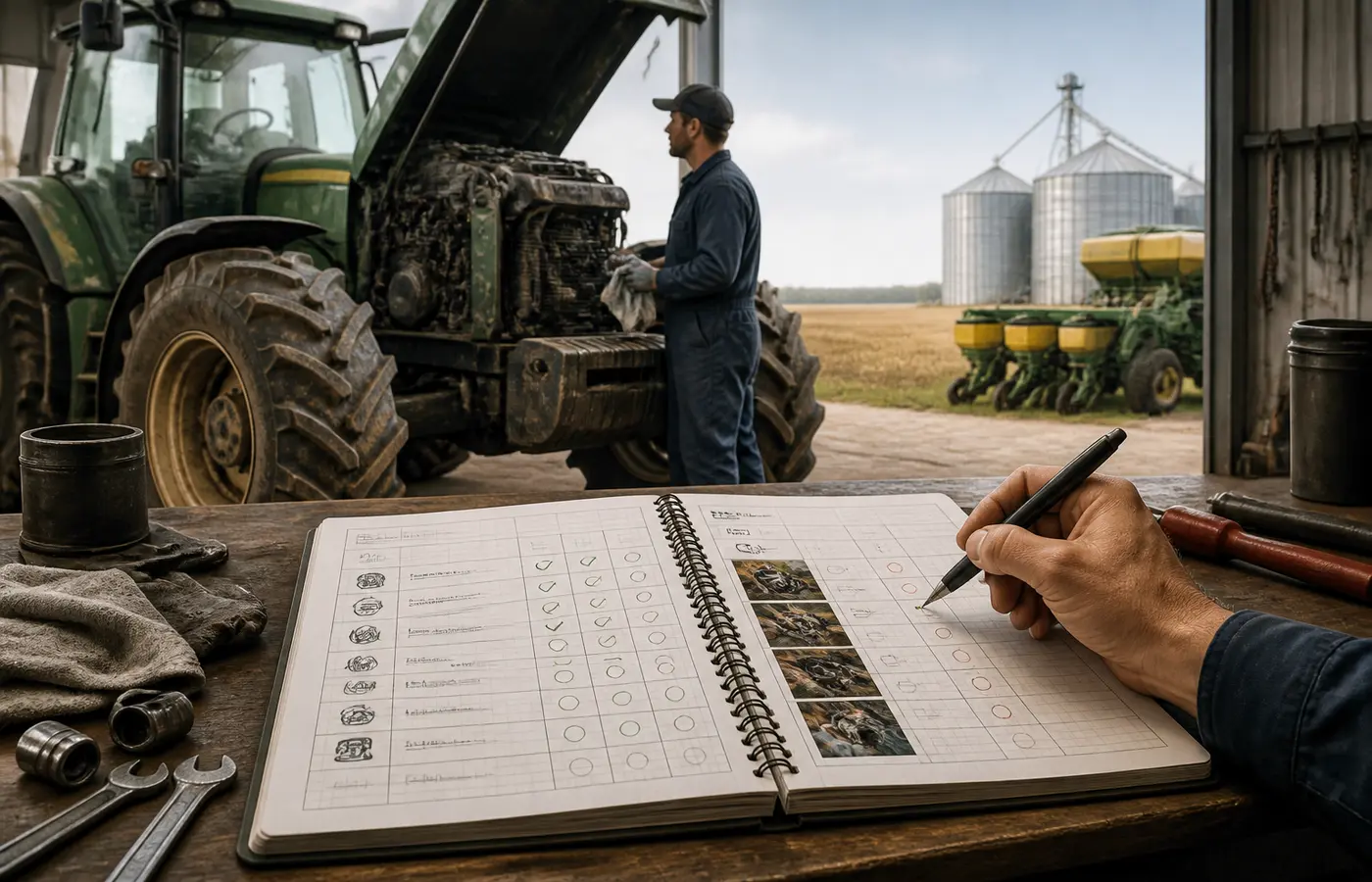
A field inspection record should allow someone else to answer a simple question later: what was actually seen, where was it seen, how much of the field was inspected, and what happened next?
That is more useful than a note saying “crop problem” or “check again soon.” It gives the next inspector, manager or adviser enough context to compare conditions without treating an early impression as an established fact.
The central discipline is simple: record the observation first, then record any interpretation separately. A visible condition can be revisited. A diagnosis, cause or treatment decision may change as more information becomes available.
Start with a record that can be revisited
Field scouting is not only a search for an immediate problem. It is also the creation of a usable record for the next visit and, where relevant, the next season.
The Ontario Agronomy Guide for Field Crops describes field scouting as walking through a field and making and recording observations at locations within it. It also advises reviewing earlier scouting records alongside current field information. That is a practical recordkeeping principle, not a China-specific operating requirement: a later decision is easier to assess when the team can see what was previously observed and how that observation was made.
An inspection record is not the same thing as a diagnosis or a treatment recommendation.
- An inspection record states what was examined and what was visible at the time.
- An interpretation states what the inspector thinks may explain the condition.
- A decision states what the operation will do, who owns that task and when it will be reviewed.
Keeping these separate does not make the record slower. It reduces confusion when an initial interpretation proves incomplete, when conditions change, or when another person takes over the field.
For example, “uneven pale foliage was visible in several areas” can remain accurate even if the eventual explanation changes. By contrast, “nutrient deficiency is spreading” combines an observation, a presumed cause and a claim about change. That wording is harder to check later.
Record the inspection context before describing a problem
A useful field note begins with context. Without it, a reader cannot tell whether the inspection covered a whole field, one block, one visibly affected patch or only an accessible edge.
CropDefense’s guidance on recording scouting observations recommends documenting the inspection route and the number of plants or sites examined. It also notes that areas with different moisture, drainage or exposure may need attention during an inspection. These are practical coverage details, rather than a universal sampling rule.
Use the following fields as an adaptable record design. They are not presented here as legal, phytosanitary or food-safety requirements.
| Record field | What to capture | Why it matters later |
|---|---|---|
| Record ID | A unique reference for the visit or inspection item | Connects photos, samples, follow-up notes and closure decisions |
| Field or block | The farm’s existing field, block or production-area identifier | Prevents records being detached from the correct area |
| Date and time | When the inspection took place | Helps distinguish a current observation from an earlier condition |
| Inspector | Person responsible for the entry | Makes clarification and handover possible |
| Crop or production stage | Record only what the team can identify confidently | Provides context without turning the entry into a diagnosis |
| Route or inspected areas | A map reference, field descriptor, coordinates or plain-language route | Shows where the inspection took place |
| Coverage | Number of sites, plants, rows or sections examined, where appropriate | Clarifies what the visit can and cannot represent |
| Limits | Access constraints, weather disruption, concentrated attention on a patch or other relevant limits | Prevents overstatement of confidence |
The University of Missouri Extension crop scouting guide discusses using field descriptors, coordinates and unique identifiers in scouting reports. It also describes using related identifiers when a field is divided into separate surveyed portions. The broader operational lesson is useful in any system: if an area is inspected separately, its record should still remain linked to the wider field history.
A coordinate is not always necessary. A clear block name, irrigation-zone reference, map pin, row range or labelled photograph may be enough for the operation. The important point is that the next person can locate the same area without relying on memory.
Write observations as visible, locatable facts
An observation should describe what the inspector could see, count, photograph or otherwise identify at the time of the visit. It should not silently assume a cause.
Useful observations commonly include:
- the plant part, surface or feature examined;
- the visible condition or pattern;
- the location and distribution of that condition;
- the area or number of sites where it was seen;
- the apparent timeline, if a prior comparable record exists;
- photo, sample or map references; and
- a statement of any inspection limit.
CropDefense advises recordkeepers to describe affected tissue, plant position, distribution and timeline, while noting when inspection attention was concentrated on a damaged patch. This matters because a close examination of one area may be appropriate, but it does not automatically establish the condition of the whole field.
Example: separate the visible condition from the conclusion
The following are hypothetical wording examples, not crop diagnosis guidance.
| Less useful record | More checkable record |
|---|---|
| “Nutrient deficiency is spreading.” | “Yellowing was visible on lower leaves at three recorded inspection sites in the southern section. The remaining route was not inspected.” |
| “There is a pest outbreak.” | “Leaf-edge damage was observed on plants at two marked locations. No organism was identified during this visit.” |
| “Disease is getting worse.” | “Compared with Record FI-024, discoloured leaf areas were visible at the previously marked location. Today’s visit used a shorter route, so the wider-field comparison is limited.” |
| “The irrigation issue caused poor growth.” | “Plants near the western boundary appeared shorter than those at two nearby inspected points. The record does not establish the cause.” |
This style can feel cautious, but it is operationally stronger. It preserves a record that remains useful if a laboratory result, adviser review, weather event or later inspection changes the working explanation.
Where photographs or samples are used, link them to the record ID. A photo without a date, location reference and basic subject description may be difficult to interpret later. The National Seed Health System field inspection procedures list field maps, labels and report forms among inspection tools and records. Those procedures concern phytosanitary inspection context and should not be treated as a general local requirement, but they illustrate the value of keeping physical or digital evidence connected to an identifiable field record.
Keep interpretation, uncertainty and action in separate fields
Interpretation is still valuable. An experienced inspector may notice a pattern that warrants faster attention, a sample, an adviser review or a return visit. The problem begins when interpretation overwrites the observed evidence.
Use separate fields for each layer of the record:
- Observation: What was directly seen or measured?
- Working interpretation: What might the observation mean?
- Uncertainty or question: What remains unknown, and what would help clarify it?
- Immediate decision: Is containment, monitoring, escalation or no immediate action required?
- Next step: Who will do what, by when, and at what location?
This is ACA’s operational framework, not a mandated inspection format. Its purpose is traceability: a reviewer should be able to move backwards from a decision to the record that supported it.
For example:
- Observation: “Irregular leaf marking observed at four sites along the recorded route.”
- Working interpretation: “Cause not confirmed; pattern may warrant further review.”
- Uncertainty: “No sample taken; underside of leaves not examined at every site.”
- Decision: “Hold routine schedule change until review.”
- Next step: “Operations lead to revisit marked sites and update Record FI-031 by the next planned inspection.”
Avoid using a confidence score unless the team has agreed what each score means. Plain language is often more useful: “unconfirmed,” “limited inspection coverage,” “awaiting identification,” or “comparison not valid because the previous route was not repeated.”
CropDefense’s printable grower field sheets connect prevention, identification, action criteria and the next inspection in one record. They also highlight retaining uncertainty alongside the sample and agreed next step. That principle is especially useful when a team is waiting for information rather than ready to make a final call.
Use a field-inspection record that supports handover
The best format is the one the operation can use consistently. A paper form, spreadsheet, farm-record application or labelled notebook can all work if records remain findable and linked over time.
A practical handover-ready structure might include the following sections:
1. Identification and context
- Record ID
- Field, block or production-area reference
- Date, time and inspector
- Crop or production-stage note, if known
- Route, map reference or inspected-zone description
- Coverage and known limitations
2. Observation and supporting material
- Visible condition
- Plant part, area or feature affected
- Distribution or pattern
- Photo, sample, map or attachment reference
- Related earlier record ID
3. Interpretation and follow-up
- Working interpretation, clearly marked as such
- Unanswered question or uncertainty
- Immediate decision or escalation route
- Responsible person
- Due date for review
- Closure note, including what changed or what remains unresolved
A closure note should not simply say “complete.” It should record what was checked and why the item was closed, continued or escalated. For example: “Revisited marked area; condition not observed beyond the previously recorded patch; routine monitoring retained.” This remains an observation-led statement rather than a claim about cause.
If a field is divided into portions for inspection, use linked identifiers. For instance, an overall field record can connect to separate entries for north, central and south portions. This preserves the relationship between areas without forcing every note into a single vague field-level statement.
Close the loop on the next visit
The next inspection is where a good record shows its value. The inspector should begin by reviewing the earlier entry before entering the field, then decide whether the earlier area, route or sample coverage can reasonably be revisited.
On the follow-up record, preserve the earlier wording rather than rewriting history. Add a new entry that states:
- whether the same area was revisited;
- whether the route and coverage were comparable;
- what was observed this time;
- what changed, if a valid comparison is possible;
- what remains uncertain; and
- whether ownership or timing of the next step has changed.
Do not describe a condition as improved, worse or unchanged if the inspection methods were materially different. A short revisit to a known damaged patch may be the right operational choice, but it is not the same as a comparable field-wide inspection.
The Ontario guide’s recommendation to review previous scouting records before a new cropping season reinforces a broader point: records become more valuable when they are actively used, not merely stored.
For your next field inspection, trial the format on one field or block. Do not redesign every record at once. Ask the next person who reads it whether they can identify the location, understand what was actually observed, see what remains uncertain and know the required follow-up. Revise the form only after that handover test exposes a real gap.
Frequently asked questions
What is the difference between an observation and an interpretation in a farm inspection record?
An observation is a direct, locatable description of what was seen during the inspection. An interpretation is a possible explanation of that condition. For example, “leaf-edge damage at two marked sites” is an observation; “insect feeding may be involved” is an interpretation. Keep both, but put them in separate fields.
What details should every farm field inspection record include?
At minimum, include a field or block reference, date and time, inspector, location or route, inspection coverage, visible observations, any supporting photo or sample reference, uncertainty, follow-up owner and next review date. The exact format should fit the operation’s existing system.
How should an inspector record an uncertain crop or pest issue?
State what was visible, identify what could not be confirmed, and record the agreed next step. Avoid replacing uncertainty with a definitive label. If a sample, photograph or external review is needed, connect that item to the same record ID and record who is responsible for follow-up.
How can two inspectors make field records easier to compare?
Use shared field identifiers, record routes or inspected portions clearly, state the number of sites or plants examined where relevant, and preserve earlier records. On return visits, state whether coverage was comparable. If it was not, describe the limitation rather than making a broad trend claim.
Source and further reading
ACA’s practical examples and working checklists are independent editorial analysis. The linked source provides the underlying reference; it does not endorse this article.