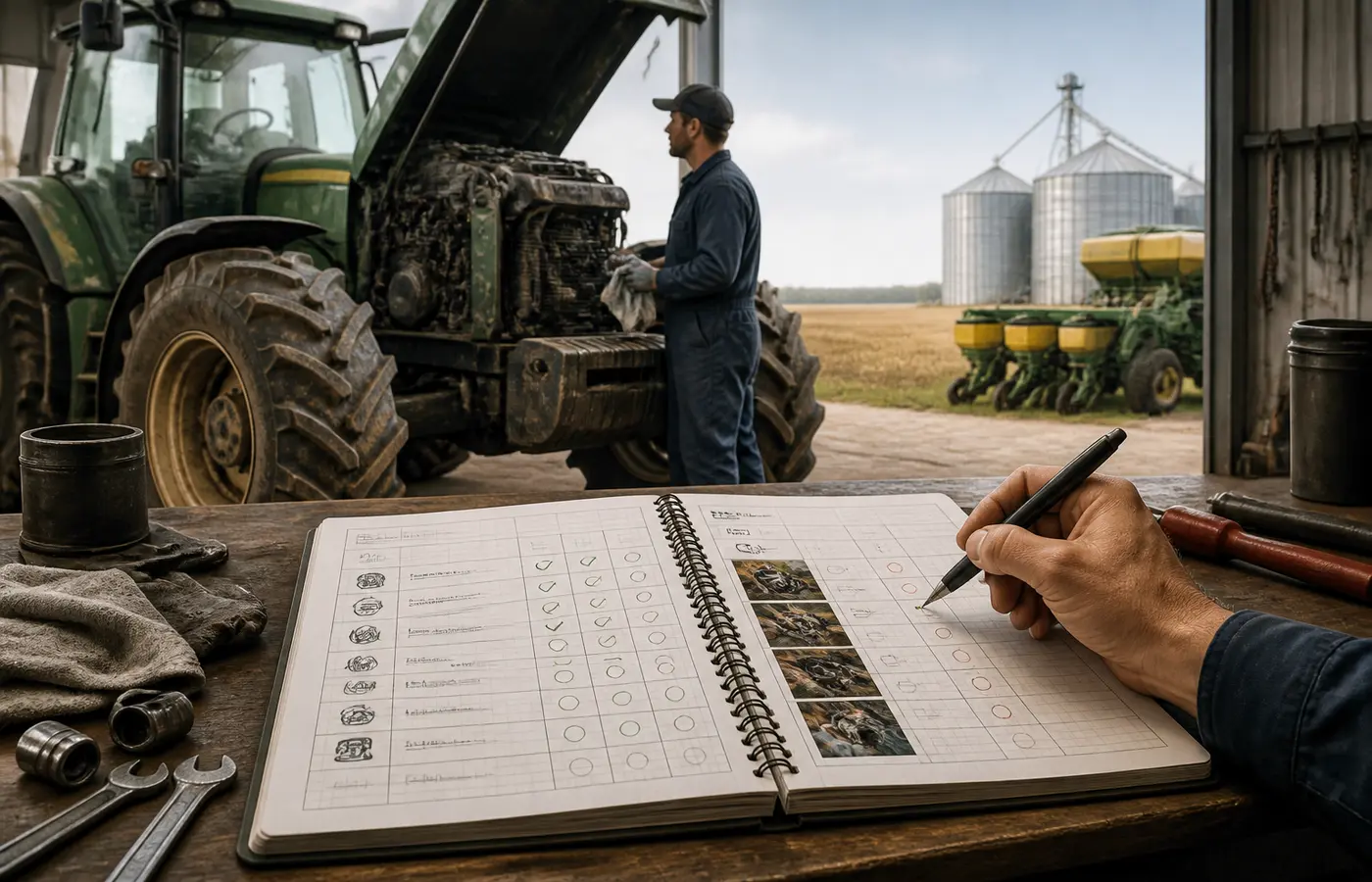
“The tractor starts” is not a complete answer to whether a farm’s machinery is ready for the season. Readiness includes the equipment attached to it, the configuration for the intended job and the status of faults found during inspection. A useful preparation plan tracks those questions through to a decision.
Iowa State University Extension’s 2022 Spring Maintenance Checklist covers more than the tractor, including tillage tools, planter setup and application equipment, and directs readers to equipment-specific instructions. Its setting is Iowa in 2022. The action register below uses that broad readiness perspective without importing machine settings, chemical instructions or a regional calendar.
Define the job before inspecting the machine
List the operations the equipment is expected to perform and the combinations of tractor and implement involved. Identify where the same machine will change tasks. An inspection can then address the planned work rather than merely confirm that equipment is present in the shed.
Keep the relevant operator’s manual and service information available. A general article should not decide a pressure, torque, calibration interval or other setting for a particular machine. Assign those checks to people qualified for the equipment and task.
Give findings a status and an owner
Describe the observation, not an unsupported cause. A recurring noise, visible wear or an operator report should remain connected to the machine and the circumstances in which it was noticed. Add photographs or service notes where they help the responsible person assess it.
Use separate states for an inspection completed, work assigned, work completed and readiness verified. Closing the inspection should not automatically close every finding it created.
| Finding record | Information to preserve |
|---|---|
| Equipment identity | Machine and relevant attachment |
| Intended operation | The job for which it is being prepared |
| Observation | What was noticed and under what conditions |
| Follow-up owner | The person responsible for the next step |
| Completion evidence | Service or other appropriate work record |
| Readiness status | Who reviewed it for the planned operation |
Connect preparation with the first field review
A workshop record and an operational observation are different kinds of evidence. Within the operation’s approved procedures, preserve any findings from the first appropriate review of the prepared equipment. Link them to the preparation record so that recurring issues do not start a new, disconnected history.
The purpose is to make feedback findable. It is not to encourage someone to continue operating equipment with an unresolved safety concern or to substitute a checklist for the manufacturer’s requirements.
Include the work performed by service providers
If a contractor or dealer carries out part of the preparation, agree what evidence the farm receives. The team should know which task was completed, which machine or component it concerned and whether any findings remain open.
A description such as “serviced” may be too broad for the next decision. Ask for an understandable scope instead of assuming it covers every item the farm had intended to check. Preserve exclusions as well as completed work.
Review what the checklist missed
At the end of a preparation cycle, ask which issue required an unexpected clarification or return visit. It may reveal an incomplete equipment identifier, unclear ownership or a missing link to the intended task. Improve that point rather than adding every possible component to a generic list.
For Chinese farm operations, the useful transfer from an overseas extension article is the discipline of considering the whole machinery workflow. The actual instructions must fit the equipment and local operation. A readiness record should tell the team what was inspected, what remains open and who can confirm the next step. The same ownership principle supports a clearer shift handover.
Source and further reading
- 2022 Spring Maintenance Checklist
Iowa State University Extension and Outreach · Accessed 2026-10-13
ACA’s practical examples and working checklists are independent editorial analysis. The linked source provides the underlying reference; it does not endorse this article.