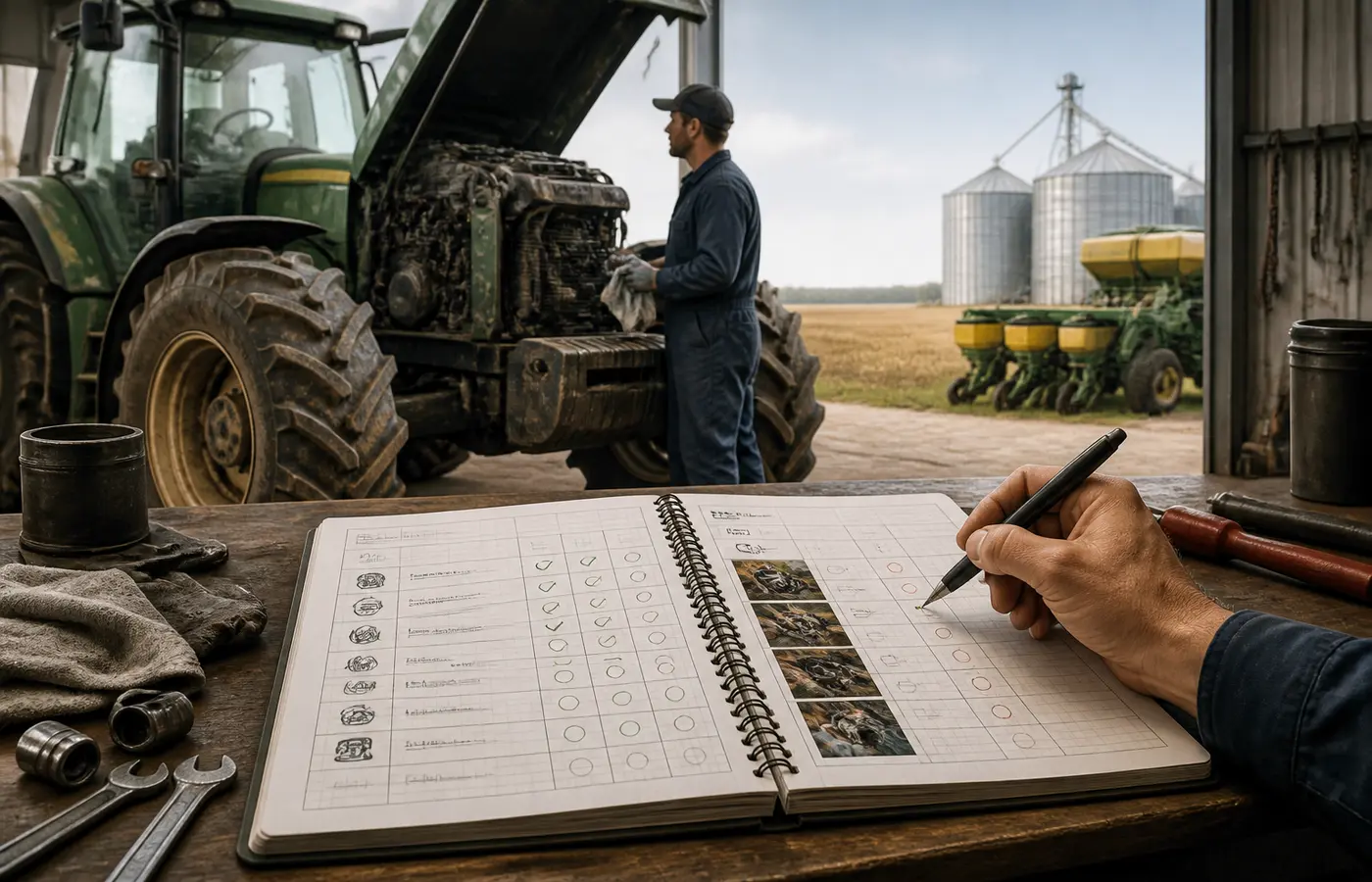
A seasonal equipment readiness check helps your team answer a scheduling question before work is committed: which machines can be assigned to planned jobs, what still needs clarification, and who owns the next follow-up?
It is not a maintenance checklist, a repair work order or a substitute for operator checks before use. Instead, it is an assignment-focused record that connects each machine to expected seasonal work, required attachments, dependencies and unresolved readiness gaps. Used well, it makes constraints visible while there is still time to adjust the work plan.
A machine marked ready in this type of record is not automatically safe, compliant, mechanically fault-free or suitable for every task. Local procedures, manufacturer information, operator checks and any applicable requirements remain separate records and decisions.
Start with the work the machine must support
Begin with the seasonal work plan rather than with a list of machines in the yard. List the work periods your operation expects to complete, then identify the equipment likely to support each one. The relevant question is not simply whether a tractor, planter, loader or transport unit is generally in good condition. It is whether it can be assigned to a particular planned role.
For example, an equipment list may show that a tractor is available. A readiness record should go further:
- What work is it expected to support?
- During which work window is it needed?
- Which implement, attachment or supporting resource is required?
- Is there a known condition or missing dependency that could affect assignment?
- Who needs to confirm that the gap has been resolved?
This approach avoids a common planning problem: treating all equipment as interchangeable when the planned work depends on a particular mounting arrangement, guidance system, shared trailer, operator handover or documentation set.
Pre-season preparation is commonly linked to the machine’s expected field role. For example, Iowa State University Extension’s planter pre-flight checklist frames preparation around getting the tractor and planter ready before seasonal field activity. That material contains task-specific maintenance considerations. It does not establish a universal readiness system for all farms or equipment types.
ACA’s practical interpretation is that the intended assignment should be the first field in a readiness check. Once the expected work is clear, the team can make a more useful decision about whether the machine is available for planning.
Use a readiness record that separates status from repair tracking
A readiness record should be short enough to review during planning, but specific enough to point people to the next action. It should not attempt to reproduce every detail from a workshop system, service log or daily inspection form.
The following fields are a practical ACA framework for one machine record:
| Field | What it should answer |
|---|---|
| Equipment identifier | Which specific asset is being discussed? |
| Intended use | What planned work is this machine expected to support? |
| Planned work window | When is that assignment expected to begin or become critical? |
| Current readiness status | Can the machine currently be assigned, conditionally assigned, or not assigned? |
| Unresolved issue summary | What remains unclear or open, in plain operational terms? |
| Required attachment or supporting equipment | What implement, trailer, system or resource must be available? |
| Record owner | Who keeps this readiness record current? |
| Follow-up owner | Who is responsible for confirming the next action or update? |
| Review date | When will the team reconsider the status? |
| Linked record | Where is the relevant maintenance, repair, inspection or planning record, if one exists? |
This record is deliberately different from a repair log. A repair log may describe work requested, parts, labour, diagnosis, completion details and repair history. A daily operator inspection may record observations made before use. A readiness record only needs enough information to support an assignment decision and prevent an open issue from disappearing between teams.
The distinction is useful because detailed records and planning records serve different handovers. A workshop may need technical detail. A scheduler may need to know whether a machine can be allocated to planting next week, which attachment must be reserved, and when the status will be reviewed.
The Inspeq farm equipment pre-season inspection template provides limited contextual support for recording details such as machine type, asset identification, operating hours or mileage, inspection purpose and the person completing the record. Its inclusion of attachments is also a useful reminder that equipment is often assessed as part of a working combination. The template does not prescribe the readiness fields above; those are ACA’s proposed planning framework.
Similarly, the University of California Agriculture and Natural Resources tractor pre-use checklist distinguishes between items recorded as acceptable and items needing repair, with space for repair follow-up. That supports the narrower point that condition observations and follow-up can be recorded separately. It should not be treated as a universal readiness standard or as a replacement for your operation’s own procedures.
Choose clear readiness categories for assignment decisions
The status label should answer one practical question: can the machine be assigned to the planned work at this point?
Avoid a long list of labels that different people interpret differently. A four-category system is usually enough for a seasonal planning view:
- Ready to assign: the record shows no known readiness gap for the stated assignment and required dependencies are identified as available.
- Ready with a planned condition: the machine can be included in the plan, but the scheduling team needs to account for a stated condition, such as a shared attachment or a confirmation due before the work window.
- Awaiting follow-up: an unresolved issue, missing information or dependency needs an owner response before the machine should be treated as available for the stated assignment.
- Not available for assignment: the machine should not be allocated to that planned work window until the readiness status is reassessed.
These are internal planning labels, not statements about safety, legal compliance, insurance, mechanical fitness or manufacturer approval. A machine might be ready to assign for one task but not another. Equally, a machine may have no open readiness issue in the seasonal list while still requiring normal checks under the farm’s established procedures.
The UC ANR checklist’s use of an “OK” and “Needs Repair” distinction is relevant as a basic recordkeeping model: an unresolved condition should be visible and linked to follow-up. ACA’s added step is to translate that visibility into an assignment decision without attempting to diagnose the condition in the readiness sheet.
For consistency, define each category in the record itself. This helps prevent one manager using “ready” to mean “present on site” while another uses it to mean “fully matched to the next planned job.”
Record attachments, dependencies and handovers
A machine is rarely ready in isolation. Its expected role may depend on an implement, a mounting arrangement, a transport resource, operating information, access to a shared system or a clear handover between people.
The readiness record should therefore include dependencies that could change the assignment decision. Do not turn the field into a technical inspection list. Keep it focused on what must be in place for the intended work to proceed as planned.
The table below is a hypothetical example of how a planning record can connect a primary machine to its dependencies. It is not an observed farm record and does not indicate that the listed equipment is ready or suitable for use.
| Primary machine | Intended work | Required attachment or dependency | Current status | Follow-up owner |
|---|---|---|---|---|
| Unit T-04 | Field preparation window | Assigned implement and confirmed availability | Ready with a planned condition | Field operations coordinator |
| Unit P-02 | Planting window | Matching tractor, planter setup record and operator handover | Awaiting follow-up | Planting lead |
| Unit L-01 | Materials movement | Shared trailer allocation and route plan | Awaiting follow-up | Yard coordinator |
| Unit H-03 | Harvest support window | Supporting transport resource and work schedule confirmation | Not available for assignment | Seasonal operations manager |
This kind of view makes resource conflicts easier to see. For example, two machines may each appear available until both are linked to the same attachment. The issue is not necessarily a mechanical one; it may be a scheduling or ownership problem.
Record handovers as explicitly as physical dependencies. If one person knows the status of an attachment, another controls the work schedule and a third maintains the machine record, then the readiness check should state who brings those inputs together. Otherwise, a status can remain “awaiting follow-up” without any person being responsible for moving it forward.
Assign one owner for each unresolved readiness gap
A readiness list becomes useful when every unresolved item has a named follow-up owner. This does not mean that the named person must perform technical work. The owner may coordinate information, request an update, confirm a booking, identify an alternate resource or bring an exception to the planning review.
For each open item, record three things:
- The gap — a brief description of what prevents a clear assignment decision.
- The owner — the person responsible for confirming the next update or action.
- The reassessment point — a date, planning meeting or other defined point when the status will be reviewed.
A useful wording pattern is: “Awaiting confirmation of [dependency]; [name or role] to update by [review point].” This keeps the readiness record factual and avoids turning it into an informal diagnosis or repair instruction.
The University of Minnesota’s historical publication, Count Your Machinery Problems Before They Hatch, makes an enduring recordkeeping point: known work should be noted while it is still remembered, rather than left to recollection before the next season. Because it is a historical publication, it should not be used as current technical guidance. Its relevance here is limited to the value of capturing known needs and connecting them to a future follow-up.
Adapt responsibility and escalation routes to your own management structure. A small farm may assign the record, follow-up and final scheduling decision to one person. A larger operation may divide these responsibilities among equipment management, field operations and seasonal planning teams. What matters is that the record makes those boundaries visible.
Run the check before scheduling is fixed, then review exceptions
The timing of the review matters. If the list is created after staffing, field windows, transport or contractor commitments are fixed, it may reveal constraints too late to give the team useful options.
A bounded seasonal workflow can be simple:
- Build or update the equipment list using the identifiers your operation already uses.
- Connect each machine to its expected seasonal assignment and work window.
- Record the current readiness category, key dependencies and any unresolved gaps.
- Name a follow-up owner and review point for every exception.
- Review the list before major scheduling commitments become difficult to change.
- Revisit only changed records and open exceptions as the season approaches.
This is not a promise that equipment failures, delays or operational disruptions will be prevented. Its value is earlier visibility: the team can distinguish between equipment that is ready to allocate, equipment that has a manageable planning condition, and equipment that should not yet be relied upon.
The Mississippi State University Extension newsletter on equipment inspections notes that equipment should be inspected before use and that the way equipment is used can affect inspection frequency. That supports the broader principle that a single seasonal record cannot replace ongoing procedures. In ACA’s framework, the readiness check is a planning layer that should link to, not duplicate, maintenance records and pre-use processes.
Frequently asked questions
What is the difference between an equipment readiness check and a maintenance checklist?
A maintenance checklist tracks tasks, observations or work needed on equipment. A readiness check tracks whether that equipment can be assigned to a specific upcoming job, considering its status, dependencies, unresolved gaps and responsible follow-up owner. The two records should link where useful, but they should not be treated as the same document.
What information should be included in a farm equipment readiness checklist?
At minimum, include the equipment identifier, intended use, planned work window, readiness status, unresolved issue summary, required attachment or dependency, record owner, follow-up owner and review date. Add links or references to existing maintenance or inspection records rather than duplicating their detail.
Who should be responsible for updating equipment readiness status?
Assign a record owner to keep the status current and a follow-up owner for each unresolved gap. They may be the same person on a smaller operation. The follow-up owner does not need to carry out every technical task; they need to ensure that the information required for reassessment is brought back to the planning process.
How often should a seasonal equipment readiness list be reviewed?
Create the initial view before seasonal scheduling is fixed, then review open exceptions whenever a work window, dependency or equipment status changes. The appropriate frequency depends on how quickly your plan changes and how many machines, attachments and operators are shared across work areas.
Start with one upcoming work period rather than rebuilding every equipment record at once. Create a short list of the machines expected to support that period, assign a readiness category to each, and give every unresolved gap one owner and one review point. Then link the list to the maintenance log or seasonal work plan your team already uses.
Source and further reading
ACA’s practical examples and working checklists are independent editorial analysis. The linked source provides the underlying reference; it does not endorse this article.