When a produce lot arrives in disputed condition, the first job is not to decide who is at fault. It is to create a record that lets both parties identify the same delivery, understand what was checked, and see what happened next.
A useful receiving disagreement record separates five things that are often blurred together: the applicable purchase requirement, the inspection method, the observed condition, the evidence retained, and the next action agreed by the parties. That separation helps a receiving team preserve information while commercial, quality or legal questions are considered through the appropriate route.
The record does not itself establish the cause of damage, liability, entitlement to a credit, or a right to reject product. Those outcomes depend on the governing agreement, the evidence available and the applicable jurisdiction. Its purpose is narrower and practical: make the condition at receiving traceable before the lot is moved, mixed, repacked or otherwise changed.
Start a dispute record before the lot is moved or mixed
Open a receiving disagreement record as soon as the team identifies an issue that may affect acceptance, use, sale or further handling. Use the delivery information already generated by your operation rather than creating a disconnected quality note with no transaction link.
The record should make it possible to answer a basic question later: which physical goods are we discussing? Depending on the receiving process, that may mean recording the delivery reference, supplier, product description, purchase order or order confirmation reference, lot or pallet markings, arrival time, vehicle reference and the receiving location.
Not every operation uses the same identifiers, and this is not a universal field list. The important point is that the identifiers on the disagreement record can be reconciled with the documents used to receive and pay for the shipment.
This distinguishes a quality disagreement from a general complaint. “Poor quality” is a complaint. “Delivery reference X, product identified as Y, pallets marked Z, received at this location at this time, with the following condition observed” is the beginning of a reviewable record.
The record should also identify the current lot status. For example, it may state that the relevant pallets were left identifiable pending instruction, or that part of the delivery was being reviewed separately from the balance. Do not record a status that did not occur. If the product has already been moved or combined with other stock, say so plainly and record the time and extent of that movement.
The DRC Good Inspection Guidelines describe the importance of defined elements in a complete produce inspection. In a different regulatory setting, the USDA AMS PACA training workbook also treats transaction records such as invoices, freight bills and inspection certificates as important support when disputes arise. These materials are useful context for record discipline; they do not establish Chinese receiving requirements or legal procedure.
Identify the specification and the point being disputed
A receiving record is more useful when it identifies the reference against which the condition is being discussed. This may be a purchase specification, product sheet, contract term, order confirmation, agreed grade reference or another quality criterion that both parties used for the transaction.
Attach the relevant document, cite its version or reference number, or state where it is held in the company system. If there is no written specification available at receiving, record that fact rather than reconstructing one from memory.
Then describe the point of disagreement in observable terms. Avoid reaching immediately for conclusions such as “supplier fault,” “rejection required” or “transport damage.” A receiving team may instead record matters such as:
- the product state visible at inspection;
- the type and location of affected packaging or units;
- whether the condition was concentrated in a defined area of the delivery or seen more broadly;
- the requirement, description or condition point that appears to be in question; and
- any uncertainty that remains pending a further review.
For example, the record can say that a condition appeared inconsistent with a specified requirement, provided the relevant requirement is identified. It should not claim that the observation proves when the condition developed or who caused it.
This is an important boundary. ACA’s practical view is that a receiving record can document an apparent mismatch with an agreed requirement. It cannot, by itself, establish cause, liability or remedy. The distinction keeps the record useful to quality, procurement and commercial teams without turning it into an unsupported determination.
The USDA’s guidance on contracting issues is also a reminder that disagreements are connected to the terms governing the sale. Its discussion is specific to the United States PACA context, so it should not be used as a substitute for a China-specific contract review or local advice.
Record how the receiving check was performed
Another person should be able to understand the basis of the observation without guessing how the team looked at the lot. Record who conducted the check, when and where it happened, and what portion of the delivery was examined.
A clear entry might include:
| Record element | What the entry should clarify |
|---|---|
| Inspector and time | Who made the observation and the time of the check |
| Inspection location | Where the product was checked, such as the receiving area or designated hold area |
| Scope | Whether the check covered the full lot, identified pallets, selected cartons or another defined portion |
| Method | The receiving method actually used, including opening, visual review, count, measurement or another documented step |
| Product handling during review | Whether the lot remained intact, was segregated, or had already been partly handled |
| Limits | What the inspection did not cover, or conditions that limited the check |
The aim is not to impose a sampling plan through a dispute form. Do not add a fixed sample size, tolerance, defect definition or temperature threshold unless it appears in an applicable contract, commodity standard or verified internal procedure.
If only a portion of the load is in question, identify that portion as clearly as possible. The Western Growers/C. H. Robinson claim procedure guidance discusses distinguishing a disputed portion from the balance of a load in its own programme context. That is a useful operational principle: describe the scope of the disagreement rather than allowing a partial finding to become an unsupported statement about the entire delivery.
Describe condition and keep evidence linked to the lot
Condition notes should be specific enough to be reviewed later. They should describe what the receiving team saw, not what it assumes happened before arrival.
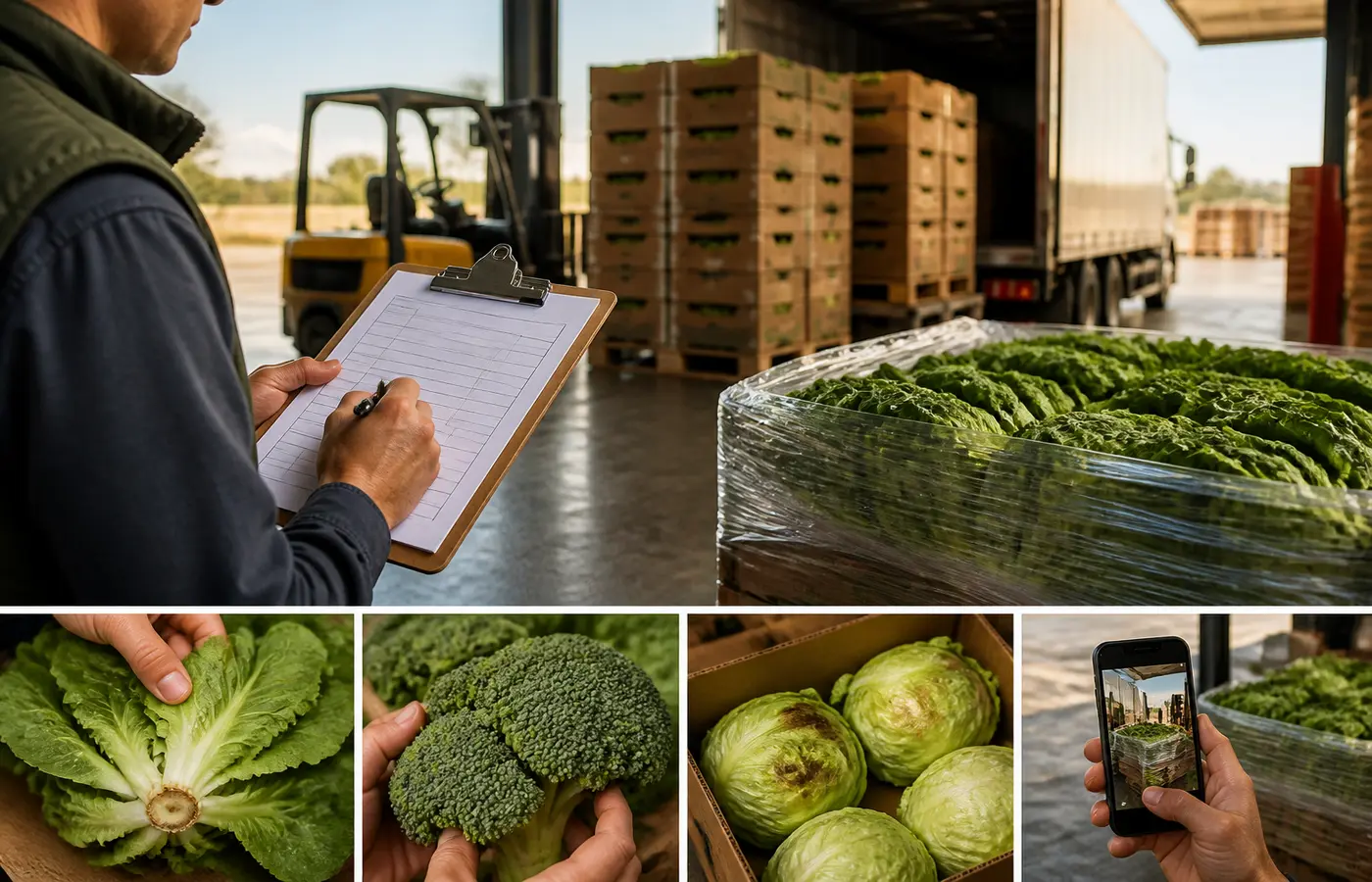
A practical condition entry may identify the affected product units, packaging condition, location within the consignment, visible product state and the time at which the observation was made. If the team took photographs, video, temperature records or other supporting material, give each item a reference and connect it to the shipment record.
Photographs are valuable supporting evidence, but they do not replace a documented inspection method. A photograph without a linked delivery reference, timestamp context, location, product identification and explanation of what it shows can be difficult to interpret later. A photograph may show a condition; it does not necessarily establish its extent across a lot, its timing or its cause.
Where records actually exist, retain relevant labels, pallet markings, receiving documents, transport documents, correspondence and inspection notes together or cross-reference them in one controlled file. The PACA workbook lists common commercial records including invoices, sales tickets, credit memoranda, freight bills and inspection certificates. Again, its legal obligations apply to its own US framework, but its recordkeeping logic is broadly useful.
Only include temperature, packaging, loading, handling or transport observations that were actually recorded. Do not infer a temperature history from product appearance, and do not state that a packaging issue caused the product condition unless there is evidence capable of supporting that conclusion.
Document notifications, lot status and the agreed next step
The disagreement record should include a simple notification log: whom the team notified, how notice was sent, when it was sent, and what response or instruction was received. This creates a shared timeline and reduces the risk that a later discussion becomes dependent on memory.
Record the product status at each important point. Depending on the agreement and the instruction received, this might state that product was held, segregated, accepted under reservation, released for use, or handled in another documented way. The form should report the status; it should not prescribe a universal response.
The Western Growers/C. H. Robinson guidance calls for prompt communication and clear arrival documentation in the context of its own claim process, including notes on a bill of lading and arrangements for an inspection where an arrival issue is asserted. Those steps may be relevant to a particular contractual arrangement, but timing, signatures, inspection routes and commercial consequences are not universal rules.
When the immediate action is agreed, record the next review point. It may be a supplier response, a joint review, a request for an independent inspection, an internal escalation or another documented decision path. Give the action an owner and a time for review where the parties have agreed one.
Inspection, rejection, resale, disposal, credit, payment and related actions depend on the governing agreement and applicable jurisdiction. Overseas industry and regulatory guidance cannot establish Chinese legal requirements, Chinese inspection standards or local operating instructions. If the outcome may affect payment, food safety, customer commitments or a continuing supplier relationship, route the record to the responsible commercial, quality and legal functions under your organisation’s own escalation process.
Use a one-page receiving disagreement checklist
A short form is often more usable at the dock than a narrative written later. The following checklist is a working documentation framework, not a legal form, product specification or mandated inspection standard.
Receiving disagreement checklist
- Shipment identification: delivery reference, supplier, product description and available lot, pallet or vehicle identifiers.
- Applicable reference: purchase specification, order confirmation, contract term or agreed quality reference.
- People and timing: receiver, inspector, arrival time, inspection time and notification times.
- Inspection scope: units or portion examined, location of the check and the method actually used.
- Observed condition: factual description of the condition and the affected area or units.
- Supporting evidence: references to photographs, video, labels, documents, measurement records or other retained material.
- Record limits: parts of the lot not examined, missing identifiers, prior handling or other limitations.
- Notification log: parties contacted, communication method, time sent and response received.
- Lot status: current physical and system status of the identified product.
- Next action: agreed review, inspection, escalation or decision point, with a named owner where applicable.
Before the next disputed delivery arrives, compare the form with your team’s purchase terms, document-control process and escalation route. Confirm who can place product on hold, who communicates with suppliers, where evidence is stored and who decides whether an independent review is needed. That preparation will not guarantee resolution, but it gives the receiving team a clearer handover when a disagreement occurs.
Questions receiving teams commonly ask
What should be recorded first when produce quality is disputed at receiving?
Start with the identifiers that connect the observation to a specific delivery: the receiving or delivery reference, product description, available lot or pallet marking, supplier and arrival context. Then record the applicable quality reference and the current lot status before the shipment is moved or mixed further.
Can photos alone support a produce quality disagreement?
Photos can support a record, especially when they are linked to the shipment, time, location and written condition notes. They do not replace an explanation of what was inspected, how much product was examined or what the image represents. They also do not independently establish cause, timing or liability.
Should a disputed produce lot be mixed with accepted product?
The record should identify whether the lot was kept distinguishable, partly handled or combined with other product. Whether it should be held, segregated, accepted or otherwise handled depends on the governing agreement, product risks and the instruction of the responsible people in your organisation. Do not let the documentation form substitute for that decision process.
When should a buyer ask for an independent produce inspection?
Consider the question when the condition is material to the transaction, the parties need an independent record, or the applicable contract or dispute process calls for one. The appropriate inspection route, timing and authority depend on the governing arrangement and jurisdiction. Record the request, the scope proposed and the response received rather than assuming that any particular inspection process is mandatory.
Source and further reading
ACA’s practical examples and working checklists are independent editorial analysis. The linked source provides the underlying reference; it does not endorse this article.