A warehouse team should be able to answer a simple question without relying on memory: where has this batch been since it entered this warehouse?
The answer does not require a complex system in every operation. It does require disciplined records. Keep the batch identifier separate from its physical address, record each completed movement as an event, make operational status visible, and preserve corrections rather than overwriting the history.
This article concerns internal warehouse location history. It does not set out receiving handovers, supplier-lot linkage, cold-chain monitoring, quality-release decisions or China-specific compliance requirements. Those processes may connect to warehouse records, but they should not be confused with the question of where a batch moved inside a site.
Start with a stable batch and location reference
Every location-history record needs to join two references:
- Batch identifier: the reference for the product quantity being tracked.
- Location code: the reference for the physical place where that quantity is stored, staged or handled.
These references answer different questions. A batch identifier answers, “What stock is this?” A location code answers, “Where is it now, or where was it at a specified time?” Moving a pallet from one rack to another does not normally create a new batch. It changes the batch’s location relationship.
The location code needs one shared meaning on the warehouse floor, in a spreadsheet or warehouse management system, and in any printed label or handheld-scanning process. A code such as WH1-Z03-R04-B02 can be useful if each segment has an agreed meaning. But a shorter code can work equally well when the warehouse is smaller. The important point is not the format; it is that the reference is unique, readable and consistently used.
All China Agriculture’s guidance on warehouse records makes the same practical distinction: location should remain separate from product identity because stock can move without becoming a different product. The V5 Ultimate inventory guide similarly recommends short, unique labels and explicit definitions for temporary and inspection areas.
Before asking operators to scan or write any movement, document the location map. Include ordinary storage positions as well as the places that are often omitted from records:
- receiving or unloading bays;
- staging lanes;
- inspection or sampling areas;
- rework or damage areas where applicable;
- packing and dispatch staging positions;
- quarantine or decision-pending spaces, if the operation uses them; and
- an identified “unknown location” process for stock that cannot immediately be found.
If the warehouse layout changes, do not silently reuse an old code for a different physical place. Retain a map of renamed, removed or relocated positions so that historical records remain interpretable.
Record every internal move as a location-history event
A location history is more reliable when it is built from events, not from a single field showing only the latest address. A current-location field is useful for daily work, but it cannot by itself explain how the batch arrived there.
For each completed internal transfer, record both ends of the move. At minimum, the record should show the batch, quantity, origin, destination and time. It should also identify the transaction type and the person or process that created the entry.
| Field | Why it is needed | Example value |
|---|---|---|
| Batch identifier | Links the event to the stock being moved | B-APR-041 |
| Quantity and unit | Shows how much moved and in what measure | 24 cartons |
| Origin location | Preserves where the quantity came from | WH1-Z01-R02-B03 |
| Destination location | Preserves where the quantity went | WH1-Z04-R01-B01 |
| Movement time | Places the event in sequence | 2026-04-08 14:25 |
| Event type | Distinguishes transfer, staging, adjustment or reversal | Internal transfer |
| Created by | Identifies the operator, device or process | Scanner ID 07 |
| Event reference | Lets the team retrieve and discuss one record | TRF-000184 |
| Status before and after | Shows whether the move also changed handling availability | Available to inspection pending |
The time recorded should be defined consistently. A team may choose scan time, physical completion time or supervisor confirmation time, depending on its process. What matters is that users understand what the timestamp represents. If a record is created later than the physical movement, the system should make that distinction visible rather than making it appear to be a real-time event.
The V5 Ultimate guide describes the basic transfer logic clearly: record identity, origin, destination and quantity, then decide when an in-transit movement becomes complete. This is useful operational guidance, not a China-specific regulatory rule.
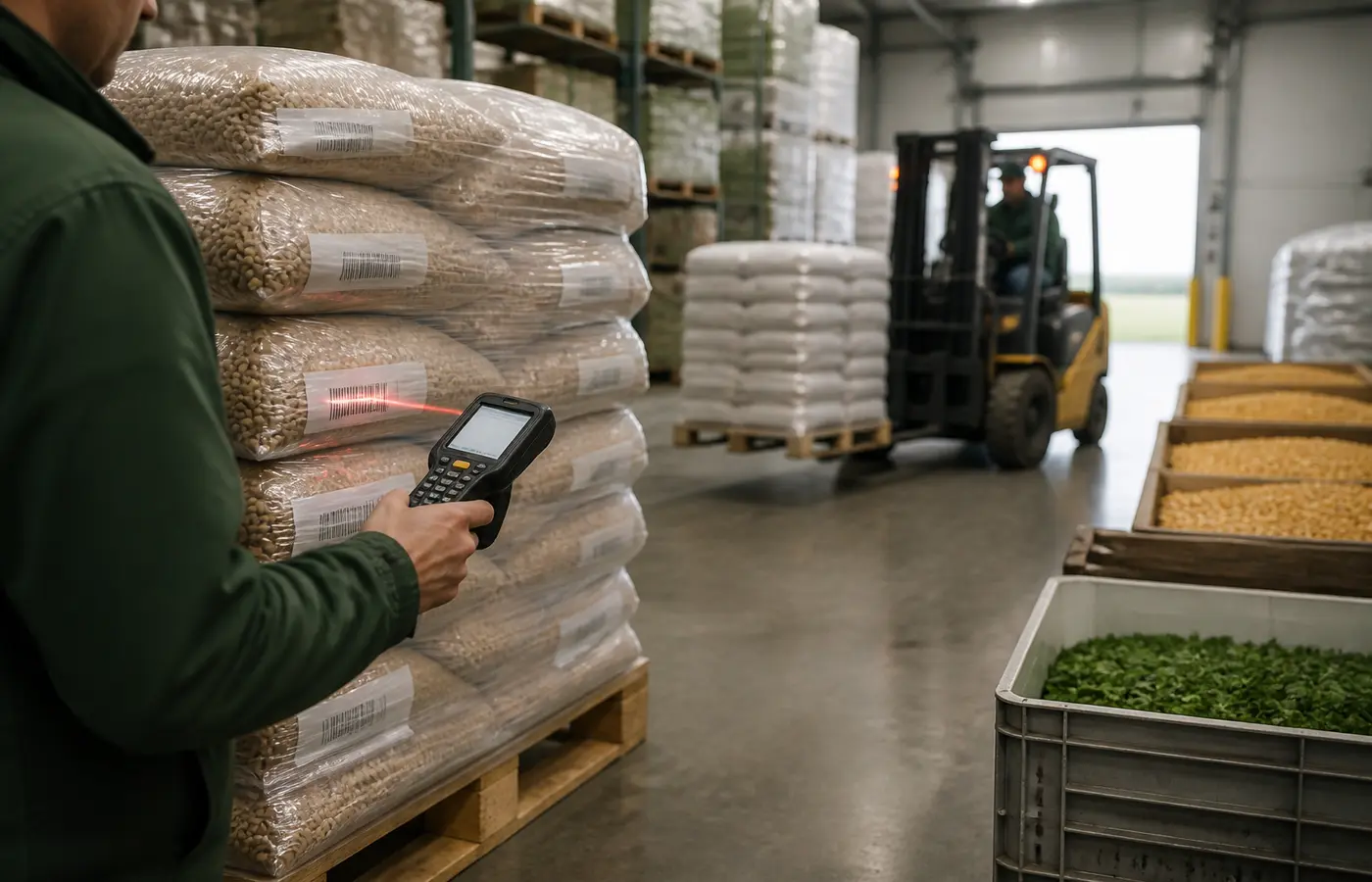
For busy warehouses, a simple rule can reduce ambiguity: do not treat a transfer as complete until the destination has been confirmed under the team’s chosen process. That may mean a destination scan, a second scan after placement, or a manual confirmation for locations without scanning coverage. The appropriate method depends on the warehouse layout, stock form and available equipment.
Make location status visible alongside the physical address
A physical address does not tell the team whether stock can be used. A batch may be in a normal rack location but awaiting inspection. It may be in a staging lane but allocated to an order. It may be in a designated area because its condition requires a decision.
For this reason, record status separately from location. Combining both concepts into a single field creates avoidable confusion. A label such as HOLD-AREA-2 may identify a place, but it does not explain whether every batch in that place is held for the same reason or whether its decision has changed.
The following is ACA practical analysis, not a prescribed standard or food-safety classification system. A team might use a small set of operational status values such as:
- Available: stock is eligible for the team’s normal next handling step.
- Reserved: stock has been assigned to a planned task or order.
- Inspection pending: stock is awaiting an internal check or decision.
- Hold: stock should not move through the normal process until an authorised decision is recorded.
- Damaged or condition review: stock requires assessment under the site’s own procedure.
- In transit: a movement has started but has not been confirmed at its destination.
- Location unknown: the recorded position has not been verified and requires investigation.
These labels should have local definitions, named decision owners and clear rules for changing them. A status field is not a substitute for quality documentation, food-safety disposition rules or legal requirements. If the operation handles regulated products, the team should verify current local obligations separately.
Keep splits, consolidations and temporary moves connected
Location history becomes difficult to reconstruct when a batch exists in more than one place. This is common when part of a pallet moves to packing, a portion is held for review, or stock is staged before dispatch.
The record should show that a partial quantity moved while retaining its relationship to the original batch. The ACA warehouse-records article recommends preserving the original connection when quantities split. In practice, the exact design depends on what the team’s spreadsheet or system can support.
A simple spreadsheet may retain one batch ID with multiple current-location lines, each carrying a quantity. A more capable system may create child handling-unit or sub-batch references linked to a parent batch. Either approach can work if the total quantity remains accountable and the relationship is visible.
For example, if batch B-APR-041 contains 100 cartons and 30 cartons move from bulk storage to a packing staging location, the record should not make it appear that all 100 cartons changed location. It should show:
- 70 cartons remaining at the original location; and
- 30 cartons transferred to the staging location.
Temporary moves need the same discipline. “Staging” should not become a vague holding place where stock disappears from the trail. If stock enters a staging lane, record the movement into that lane. When it leaves, record the next destination. The V5 guide specifically highlights testing partial moves and wrong destination scans; these are useful cases to test before relying on a new workflow.
Consolidation requires similar care. If several handling units from the same batch are placed together, retain their individual movement histories where needed. If different batches are combined physically, do not create an ambiguous shared record that prevents the team from identifying each batch’s quantity and prior location.
Handle discrepancies without rewriting the movement trail
Warehouse records will contain mistakes and uncertainty. A destination may be scanned incorrectly. A pallet may be moved physically before the transaction is completed. A count may not match the recorded quantity. Stock may be found in a location not shown in the system.
The practical response is not to erase the prior movement and pretend it never happened. Preserve the original event, then create a linked correction, reversal or investigation record. This gives the team a usable history and helps distinguish a data-entry mistake from a recurring process problem.
ACA practical analysis suggests that an exception record should include:
- the affected batch and quantity;
- the movement event or prior record being questioned;
- the discrepancy type;
- the time the issue was identified;
- the person or role responsible for investigation;
- the temporary status and current known location, if any;
- the corrective event when the issue is resolved; and
- a short reason or evidence note suitable for the operation.
For a wrong-destination entry, the team may record a reversal from the incorrect destination back to the origin or an intermediate exception state, followed by the correctly confirmed transfer. The right sequence depends on whether the stock actually reached the wrong physical location. Do not use a correction entry to imply a physical move that did not occur.
For an unconfirmed transfer, keep the stock in an explicit in-transit or exception state until the team verifies its position. The V5 guide’s recommendation to define completion and assign responsibility for discrepancies is especially relevant here. An abandoned transaction should have an owner; otherwise it can remain open while the physical stock continues moving.
Test whether the record can reconstruct a batch’s path
A location-history design should be tested with retrieval, not assumed to work because all fields exist. The following is an ACA operational check, not evidence of a validated audit procedure or a guarantee of recall readiness.
Choose one batch reference and ask a person who was not involved in its recent movements to retrieve:
- the batch’s recorded current quantity by location;
- every movement event in time order;
- each status change associated with the batch;
- any open discrepancy, in-transit record or unresolved count difference; and
- the total quantity represented across all active locations and statuses.
Where the operation permits, compare the result with a physical check. The purpose is not to expect a perfect result on the first attempt. It is to identify whether the record can explain a mismatch: an incomplete scan, a delayed entry, a partial move, a count issue or a genuine unknown location.
Here is a hypothetical sequence for illustration only:
| Time | Event | Quantity | From | To | Status after event |
|---|---|---|---|---|---|
| 08:10 | Put-away completed | 100 cartons | Receiving bay | Z01-R02-B03 | Available |
| 11:45 | Partial transfer | 30 cartons | Z01-R02-B03 | Packing stage P01 | Reserved |
| 12:20 | Destination discrepancy opened | 30 cartons | P01 | Unknown pending check | In transit |
| 12:35 | Physical location verified and correction recorded | 30 cartons | P01 | Packing stage P02 | Reserved |
This sequence preserves the uncertainty rather than hiding it. A reviewer can see that a transfer was questioned, who needs to investigate it, and what correction resolved it.
The U.S. Food and Drug Administration’s distribution-center traceability plan example is another illustration of how warehouse transactions can support record workflows. It is a U.S. regulatory-context document and should not be treated as a China legal requirement or as a ready-made procedure for a Chinese warehouse.
Frequently asked questions
What fields should a warehouse batch movement record include?
At minimum, include batch identifier, quantity and unit, origin location, destination location, movement time, event type and the person, device or process that created the record. Add an event reference and status information where the operation needs to retrieve corrections or open exceptions.
How should a warehouse record a batch that is split across several locations?
Keep the same parent batch reference visible while recording the quantity at each location. A spreadsheet may use several location lines for one batch. A warehouse system may use linked child handling-unit references. In either case, ensure the quantities across locations can be reconciled to the batch total.
Should batch status and warehouse location be recorded in the same field?
Usually no. Location identifies where stock is. Status identifies how the operation should treat it. Keeping separate fields makes it easier to see, for example, stock that is physically in a normal rack but temporarily unavailable pending a decision.
How can a team correct a batch transfer entered against the wrong location?
Keep the original movement event and create a linked correction or reversal record. Record what physically occurred, what was entered incorrectly, who investigated the discrepancy and which event establishes the confirmed location. Avoid silently editing history if the operation needs to reconstruct what happened.
A useful next step is to select one active batch and run the retrieval check using your present records. If the team cannot identify every location, quantity, movement and open exception, improve the record design before adding more labels, scans or software features. For the wider record structure around storage and dispatch, see Warehouse records that let you find a batch in both directions.
Source and further reading
ACA’s practical examples and working checklists are independent editorial analysis. The linked source provides the underlying reference; it does not endorse this article.