Crop residue management planning is most useful when it starts with a clear operational question: what must happen in this field next, and what field condition will that work require?
That question changes residue handling from an isolated post-harvest decision into part of a field-operation sequence. The next task may be planting, nutrient application, irrigation preparation, traffic by machinery, cover-crop establishment or a period of waiting for suitable conditions. Each task can place different demands on surface cover, residue distribution, access and timing.
There is no single residue practice that fits every field. A useful plan instead makes the field condition, intended outcome, constraints and follow-up check visible to the people handing work from one operation to the next.
Start with the next operation, not a preferred residue method
Before deciding whether residue should be retained, redistributed, cut, incorporated, removed or left undisturbed, identify the next field operation and its working window.
For example, a planting team may need residue to pass through equipment without accumulating in one area or interfering with the intended planting conditions. A field that will receive another pass may need access when soil moisture and traffic conditions allow. A team concerned about exposed ground may place greater weight on maintaining surface cover. These are planning questions, not automatic instructions.
The USDA Natural Resources Conservation Service describes its no-till residue and tillage management standard as managing the amount, orientation and distribution of crop and plant residue while limiting soil disturbance. Its stated purposes include reducing erosion and managing surface conditions. That description is useful as a way to identify what should be observed and discussed, even though the standard itself is not a China-specific operating instruction. See the USDA NRCS Code 329 standard for its full scope and conditions.
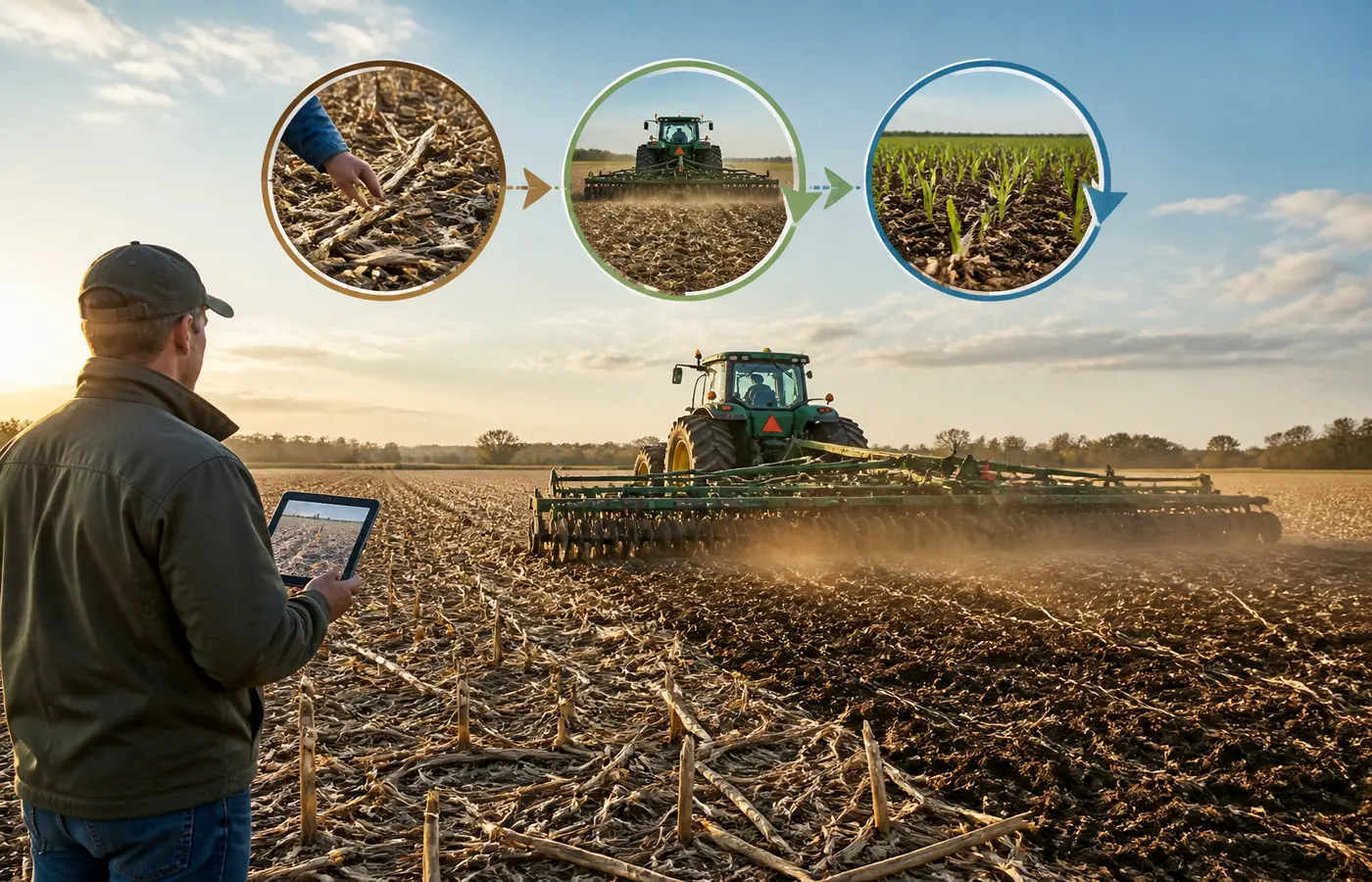
ACA’s practical planning sequence is simpler:
- Name the next operation.
- Define the field condition that operation needs.
- Record the current residue condition and uneven areas.
- Identify constraints, including timing, access and local requirements.
- Choose an approach that makes the trade-offs explicit.
- Review what happened during the next operation.
This is a working framework, not a formal standard. Its value is in making assumptions visible before equipment and labour are committed.
Record the residue condition before choosing an action
A residue decision made from a single view at the field entrance can miss the variation that matters most to the next operation. Material may be concentrated in one pass, flattened in another, broken down in a wet area or sparse on more exposed ground. The first task is therefore observation, not a conclusion about what the whole field needs.
A useful field record can include:
- Previous crop and the last operation completed.
- General residue appearance across the field.
- Whether material is mainly standing, lodged, chopped, long, matted or partly decomposed.
- Distribution across rows, between rows and headlands.
- Areas with visibly heavier or lighter residue.
- Wet patches, ruts, compacted areas or other traffic concerns.
- Slopes, exposed zones or locations where water movement may be relevant.
- Known constraints for the next operation, such as access, timing or available equipment.
Do not turn these notes into unsupported estimates of residue quantity. A visual planning record helps a team compare conditions and communicate handovers; it is not automatically a precise measurement method.
The principle of observing more than one area is supported by Iowa State University guidance on methods for measuring crop residue. The guidance notes that averaged results from repeated measurements across several areas provide a better estimate than a single observation. If your team needs a formal residue measurement, use an appropriate verified protocol and record the method, locations and date rather than relying on a general visual impression.
Within-field variation is also an important planning issue. Washington State University material on crop residue notes that variation can be associated with differences in soils, slopes, water, nutrients, pests and their interactions. That does not establish the cause of a pattern in any individual Chinese field. It does, however, support the practical habit of recording uneven zones rather than treating the field as uniform.
Match residue decisions to constraints and intended outcomes
The purpose of a residue plan is not to prove that one outcome matters more than all others. It is to identify what must be protected or enabled in the specific field and operation sequence.
Use questions such as these during planning:
| Planning area | Questions for the operator or field manager |
|---|---|
| Surface condition | Where does the team want surface cover to remain, and where is ground already exposed? |
| Next operation | What must the planter, applicator or other equipment be able to do without interruption? |
| Residue flow | Is material likely to be evenly distributed, or are there concentrated areas that need attention? |
| Seed-zone or placement conditions | What conditions are required for the planned operation, and what observations suggest potential difficulty? |
| Traffic and timing | Can the next operation wait for suitable access conditions, or is the timing window narrow? |
| Removal or use elsewhere | Is any residue expected to leave the field, and what related field-management decisions need review? |
| Uneven zones | Should a particular area be handled differently, monitored separately or left out of a general approach? |
This table does not produce a universal answer. It creates a discussion record for the people responsible for harvest, residue handling, land preparation and establishment.
Residue can serve more than one function, and those functions can compete. Retaining material on the surface may be important to one field objective, while a subsequent operation may be sensitive to concentrated or poorly distributed material. Removing material may change what the next field-management plan needs to consider. The University of Minnesota’s crop residue management guidance is useful context for considering residue harvest and tillage together rather than as unrelated choices.
Likewise, Iowa State University guidance on planter adjustment in high-residue systems notes that weather and the condition of soil and residue can affect outcomes and equipment operation. This is not a basis for applying particular equipment settings in another region or crop system. It is a reminder that the operational result depends on actual field conditions, not simply on a residue-management label.
Build a one-field planning record for the handover
A short record is often more useful than a long general instruction. It allows one team to explain what it saw, what it intends to do and what the next team should check.
The following format is ACA’s operational record template. It is not a regulatory form, measurement protocol or guarantee of field performance.
| Record item | What to enter |
|---|---|
| Field and date | Field identifier, observation date and observer |
| Previous crop and operation | Previous crop, harvest condition and most recent field pass |
| Observed residue condition | Distribution, orientation, breakdown, heavy zones and sparse zones |
| Next operation | The task to be completed, such as planting, application or traffic access |
| Required field condition | What the next operator needs to complete the task as planned |
| Constraints | Timing, moisture, equipment availability, uneven ground, local rules or buyer requirements |
| Chosen handling approach | A clear description of the intended action, including any areas treated differently |
| Responsibility | Person or team responsible for carrying out and confirming the action |
| Timing window | Planned date range or operational trigger |
| Follow-up check | What the next operator should observe and report back |
Keep the language observable. Write “residue concentrated in the north headland” rather than “residue will cause establishment failure.” Write “wet area marked for review before the next pass” rather than assuming why it is wet or what it will do to the crop.
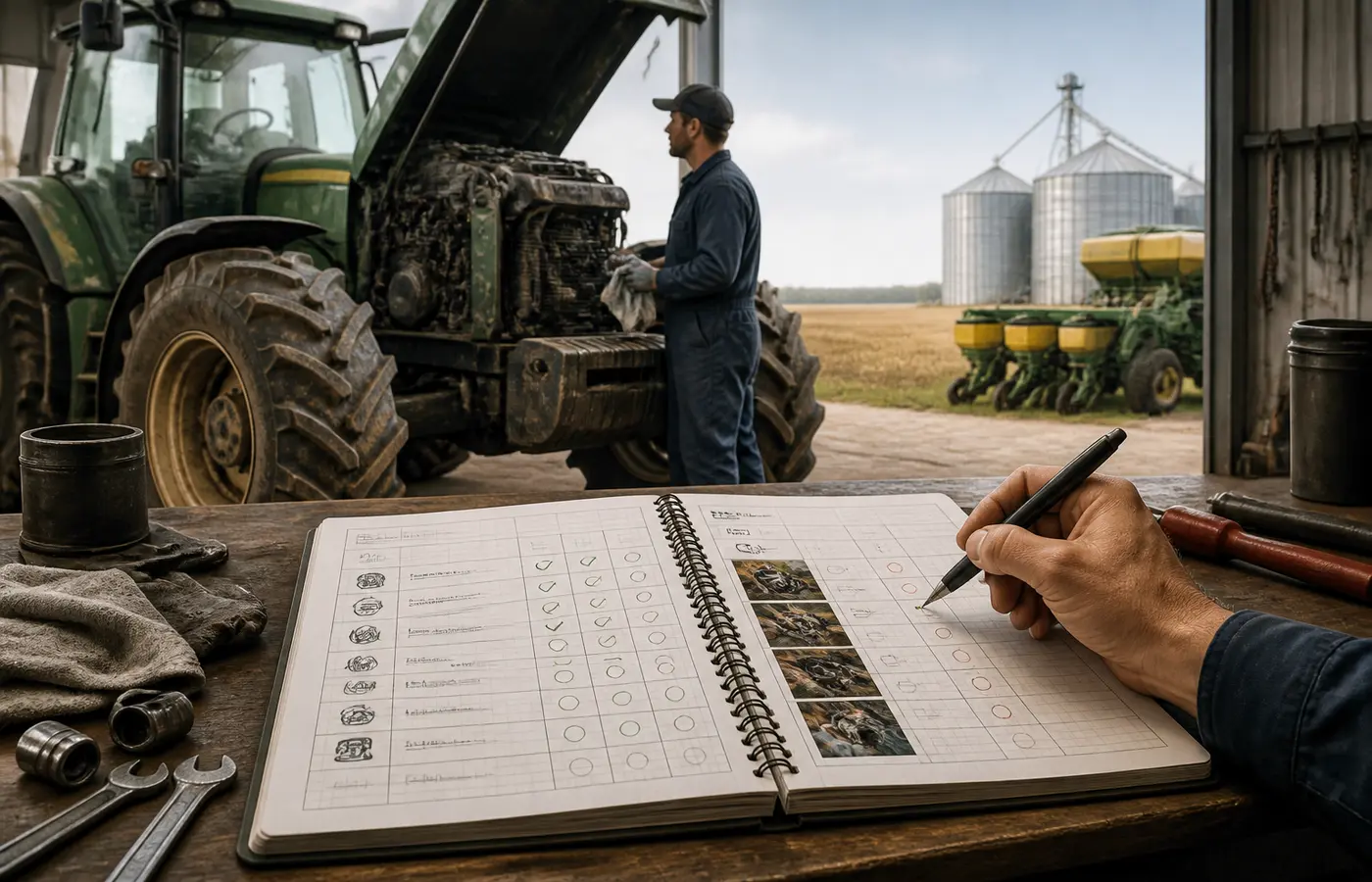
This distinction matters during a handover. The harvest team may know how residue was left. The planting or field-operations team may know what equipment access is required. Neither team needs to rely on memory or an informal assumption if the record travels with the field plan.
Check the result at the operation that follows
A residue plan is incomplete until the next operation is reviewed. The review does not need to become a large trial. It should simply compare what the team expected with what the operator encountered.
At the next operation, record practical observations such as:
- Whether residue moved through the equipment as expected.
- Whether access and travel were possible in the planned areas.
- Whether surface cover appeared distributed as intended.
- Whether there were concentrated, bare, wet or otherwise uneven zones.
- Whether the timing window was met or changed.
- What should be recorded differently before the next cycle.
Avoid treating any one observation as proof of a specific cause. A blockage, uneven pass or delayed operation may have several contributing factors, including weather, soil condition, equipment condition, travel pattern or residue characteristics. The record should preserve what happened first; diagnosis can follow when there is sufficient field-specific information.
Over several cycles, this feedback loop can improve the quality of planning. It gives the team a field history of conditions, decisions and operational consequences without pretending that every outcome can be predicted in advance.
Keep global guidance separate from local requirements
The USDA and US university resources cited here provide useful concepts: observe residue amount, orientation and distribution; sample more than one part of a field; consider the next equipment operation; and recognise that residue, soil and weather conditions interact.
They do not establish Chinese legal requirements, local technical standards, crop-specific recommendations, machinery settings or permissions for residue use. Their geographic setting, production systems and institutional role should remain clear in the field record and management discussion.
Before making a field-specific change, verify applicable local requirements and arrangements. These may include restrictions related to burning, residue movement or use, crop and soil considerations, machinery guidance, cooperative or contractor responsibilities, and buyer or certification requirements where relevant.
The bounded next step is straightforward: choose one field scheduled for a known next operation, complete a one-field planning record before any residue decision is finalised, and ask the next operator to return the record with observations. That creates a usable basis for the next decision without assuming that one residue practice should apply everywhere.
Questions operators often ask
What should be recorded before deciding how to manage crop residue?
Record the previous crop, current residue distribution and condition, uneven areas, traffic or moisture concerns, the next operation, its timing window, operational constraints and the follow-up check. Focus on observations rather than unsupported estimates or predictions.
How can a farm team assess whether residue is evenly distributed across a field?
Observe and record several representative areas rather than relying on one location. Note heavy, sparse, lodged, wet or exposed zones separately. If a precise residue measurement is needed, use a documented method suited to that purpose rather than treating a visual record as a formal measurement.
Should crop residue planning be reviewed before planting or after harvest?
Both points matter, but they serve different purposes. After harvest, the team can record how residue was left and what condition the next operation may face. Before and during the next operation, the team can check whether the plan matches actual field access, residue flow and placement conditions.
Can overseas residue-management guidance be used as a field instruction in China?
It can support general planning questions, but it should not be treated as a Chinese field instruction. Verify local law, technical guidance, crop conditions, machinery requirements and commercial arrangements before changing a field practice.
Source and further reading
ACA’s practical examples and working checklists are independent editorial analysis. The linked source provides the underlying reference; it does not endorse this article.