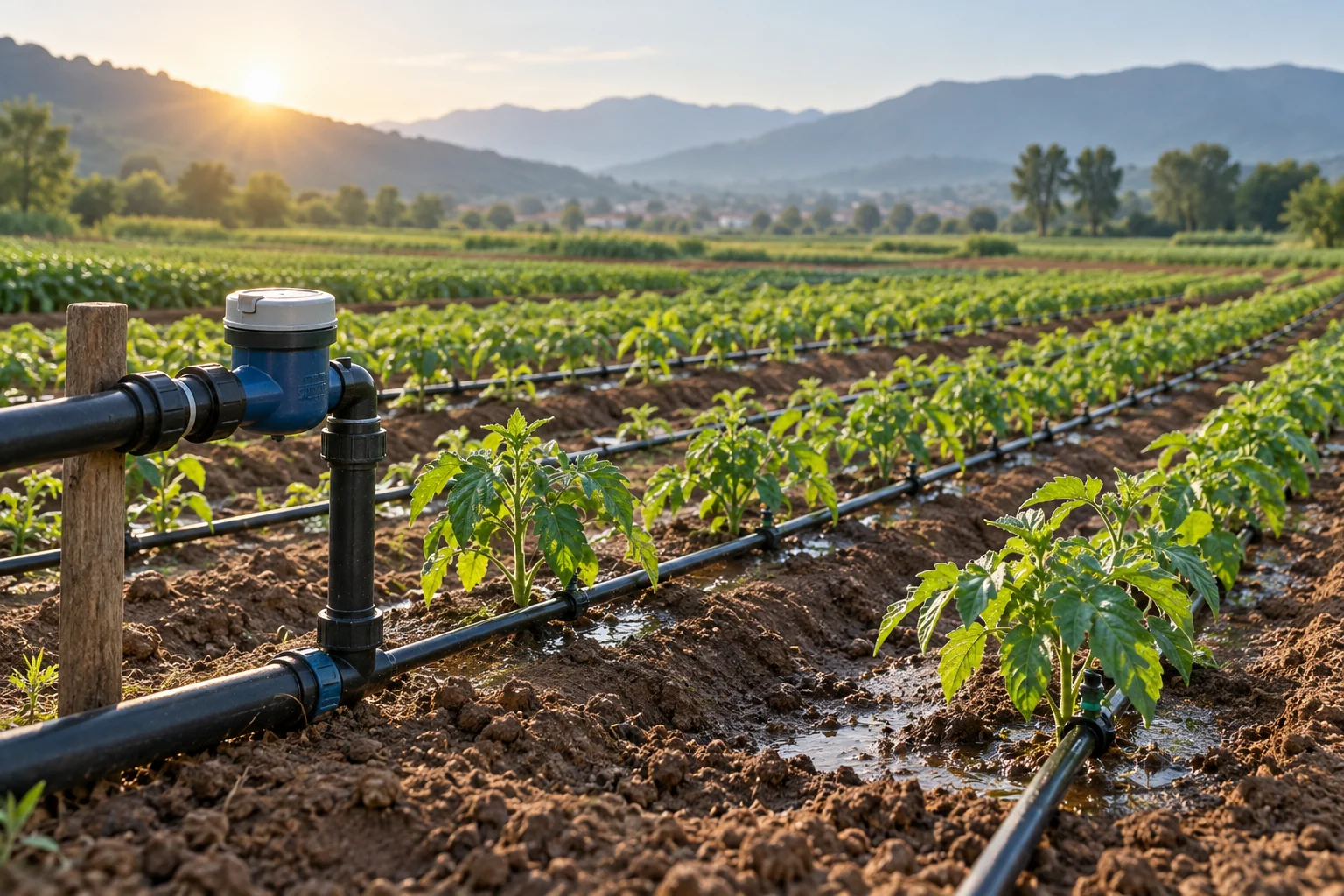
An irrigation plan is useful only if the team can later see what was actually completed. A planned-versus-completed record creates that connection. It shows what was scheduled, what happened in the field, what is known about the difference and who should take the next action.
This is an execution and handover tool. It does not prove that the planned timing or intended amount was agronomically correct. Nor does it establish that a crop received the right amount of water. Those questions require field-specific assessment using the farm’s own crop, soil, water-source, equipment and local management information.
The immediate task is simpler: make each irrigation task comparable enough that a supervisor, operator or incoming shift can understand whether the work was completed as planned.
Start With One Comparable Plan Record
Comparison begins before irrigation starts. A plan entry needs enough detail to be matched with a later completed-work entry. A vague note such as “irrigate north field” may be understandable to one operator on one day, but it becomes difficult to review after a schedule change, staff handover or equipment issue.
For each planned task, record the minimum information needed to identify the work:
- planned date or intended time window;
- field, block, greenhouse section or irrigation zone;
- crop or planting area identifier where this helps distinguish nearby areas;
- system, pump, line or water source identifier where relevant;
- intended runtime, target application or another planned measure, if the farm uses one;
- person, shift or team responsible for completion; and
- current status, such as planned, cancelled, rescheduled or completed.
The intended application does not have to be expressed as a water volume if the farm cannot measure it reliably. A planned runtime, valve sequence or irrigation set may still be a useful reference point. The important point is that the team uses the same unit or description in the plan and completed entry where possible.
ACA’s framework for recording irrigation plans and actual field work provides a practical starting structure for linking these records. The purpose is traceability: a reviewer should be able to find one planned task and locate the completed-work record that corresponds to it.
Accurate records are also part of broader irrigation management. NDSU Agriculture’s irrigation planning checklist identifies record keeping as an important component of managing irrigation within the wider farm enterprise. That is useful general context, rather than a prescribed record format for every farm.
Record What Was Completed Before Explaining the Difference
Complete the work record as close to the activity as practical. If records are filled in only at the end of a busy week, the team may remember that irrigation occurred but not which zone was changed, when a system stopped or whether a task was only partly completed.
A completed-work entry can include:
- actual date and time window;
- field or zone irrigated;
- operator or responsible team;
- actual runtime or applied amount, where recorded by the farm’s equipment or measuring process;
- system status, including a normal completion, interruption, fault or manual adjustment;
- completion status; and
- a short factual observation or note.
Keep recorded values separate from reconstructed values. If a flow meter was unreadable, a runtime was not captured or an operator cannot verify the quantity applied, mark the value as “not recorded” or “unavailable.” Do not fill the blank with an estimate unless the record clearly identifies it as an estimate, explains its basis and distinguishes it from a measurement.
This distinction matters during later review. A blank amount does not mean that no water was applied. It may mean the amount was unmeasured, the measurement was not recorded or the entry has not yet been completed. Those are different operational conditions and should not be merged into one conclusion.
Similarly, “completed” should describe the task status, not the agronomic outcome. A zone can be irrigated according to the work instruction while a later crop or soil review raises a separate question about whether the underlying plan should change.
Compare the Records in a Simple Review Table
The comparison should make differences visible without turning the record into a complicated report. One row can represent one planned irrigation task, one zone or one linked group of zones, depending on how the operation assigns work.
| Comparison item | Planned entry | Completed entry | Variance or observation | Evidence attached | Follow-up owner | Review status |
|---|---|---|---|---|---|---|
| Timing | Intended date or window | Actual date or window | On time, early, delayed or not completed | Shift log, controller record or operator note | Named reviewer or operator | Open, checked or closed |
| Location | Field, block or zone | Field, block or zone served | Matched, substituted or partly completed | Zone list, controller history or map reference | Irrigation lead | Open, checked or closed |
| Amount or runtime | Intended measure, if used | Recorded amount or runtime, if available | Difference, unavailable measurement or unrecorded value | Meter reading, timer record or none available | Record owner | Open, checked or closed |
| System condition | Expected system or source | System or source used and condition noted | Normal, interrupted or equipment issue reported | Maintenance ticket, photo or note | Maintenance contact | Open, checked or closed |
| Completion | Planned task | Completed, partial, cancelled or rescheduled | Reason stated where known | Work log or handover note | Responsible supervisor | Open, checked or closed |
The table is an ACA operational tool, not a formal irrigation standard. Its purpose is to support a useful conversation at handover: what was planned, what was done, what evidence is available and what remains unresolved.
The comparison should not impose a universal threshold for an acceptable delay or amount difference. Irrigation scheduling is conditional on local factors, including crop needs and site conditions. University of Minnesota Extension’s overview of irrigation scheduling provides broad context on that conditional nature. It does not establish a schedule, threshold or legal requirement for farms in China.
Classify Deviations So the Handover Is Useful
A short deviation category helps the team sort records without overstating what the difference means. The category should describe execution against the plan, while the accompanying note preserves the known facts and uncertainty.
Useful categories may include:
- Delayed: work occurred after the intended date or window.
- Early: work occurred before the intended date or window.
- Partial: only part of the planned field, zone sequence, runtime or application was completed.
- Not completed: the planned task did not occur.
- Substituted zone: a different zone was irrigated in place of, or in addition to, the planned zone.
- Unrecorded amount: irrigation may have occurred, but the amount or runtime was not captured.
- Equipment issue: an equipment condition was reported as affecting execution.
- Plan changed: the task was deliberately altered before or during the work.
Use the reason field carefully. “Pump stopped at 14:20; remaining zones not confirmed” is more useful than “equipment problem.” “Operator reassigned; task moved to next shift” is more useful than “delayed.” A clear operational note allows the next reviewer to distinguish a confirmed event from an assumption.
These categories do not by themselves show crop stress, water waste, system failure or non-compliance. They are administrative labels for reviewing whether field work matched a plan. Agronomic interpretation should be documented separately and assigned to the appropriate person.
Assign Follow-Up Without Turning the Record Into a Universal Irrigation Schedule
The value of comparison is not in creating a long list of exceptions. It is in assigning only the action needed to close an uncertainty or update the next plan.
A reviewer can use a bounded follow-up list such as:
- Confirm a missing record. Ask the responsible operator to verify an unread meter, controller history or completion time while the event is still recent.
- Check a reported equipment issue. Create or link a maintenance task when the record indicates a fault, interruption or abnormal system condition.
- Update the next work plan. If a task was knowingly rescheduled or a zone was substituted, revise the next plan so it reflects the confirmed operational position.
- Escalate repeated unexplained variance. Repeated missing entries, recurring substitutions or similar unexplained deviations may justify a supervisor review of the workflow, staffing, equipment records or plan design.
- Separate agronomic review from record closure. Where a difference may affect future irrigation decisions, refer it to the person responsible for field and crop assessment rather than treating the work log as sufficient evidence.
This separation prevents a common error: using a completed-work record as if it were an irrigation recommendation. The completed record answers whether the planned task was executed and documented. It does not, on its own, answer whether further irrigation is needed.
The overseas extension materials cited here provide general management context. They do not establish Chinese water-allocation rules, local irrigation requirements, farm-specific operating instructions or crop-specific schedules. Your team should use applicable local requirements and its own verified field information when making those decisions.
Use a Short Weekly Review to Improve the Next Plan
A short review can be enough if it focuses on open items rather than rewriting the whole irrigation history. A team might use a weekly review, or another cadence that fits its operating rhythm, to check:
- planned entries that have no linked completion record;
- completed entries with no stated variance where planned and actual details differ;
- partial, cancelled or substituted tasks that affect the next plan;
- unavailable measurements that need confirmation; and
- equipment issues or repeated record gaps that remain open.
Close records when the known facts are clear, not when every possible explanation has been found. If an amount remains unavailable, the closed record can still state that it was unavailable. The important point is that the next planner does not mistake missing information for a confirmed result.
For the next planning cycle, carry forward only confirmed changes: a rescheduled task, a maintenance restriction, an updated zone assignment or a recordkeeping action. This keeps the irrigation plan current without using the review process to make unsupported agronomic assumptions.
Use the comparison alongside ACA’s guide on recording irrigation plans and actual field work. Start with one field, block or system for the next review period, ensure each planned task has a matching completion status and assign follow-up only where the record leaves a decision or handover question unresolved.
Frequently Asked Questions
What should be recorded if the applied irrigation amount is not measured?
Record the work that can be confirmed: the date, time window, field or zone, system used, operator and completion status. Mark the amount or runtime as “not measured,” “not recorded” or “unavailable,” as appropriate. Do not treat the absence of a measurement as evidence that no water was applied.
Is a completed irrigation record the same as proof that the crop received the right amount of water?
No. A completed record documents execution against a plan. It can show that a task occurred, was partial, was delayed or had an equipment issue. Whether the crop received an appropriate amount of water is a separate agronomic question that depends on field-specific conditions and should not be inferred from task completion alone.
How should a team record an irrigation task that was only partly completed?
Mark the task as partial and state what portion was confirmed, such as the completed zones, recorded runtime or stopping point. Record the known reason if available, such as an interruption, staffing change or equipment condition. Then assign a specific follow-up: confirm remaining work, update the next plan or open a maintenance check.
Source and further reading
ACA’s practical examples and working checklists are independent editorial analysis. The linked source provides the underlying reference; it does not endorse this article.