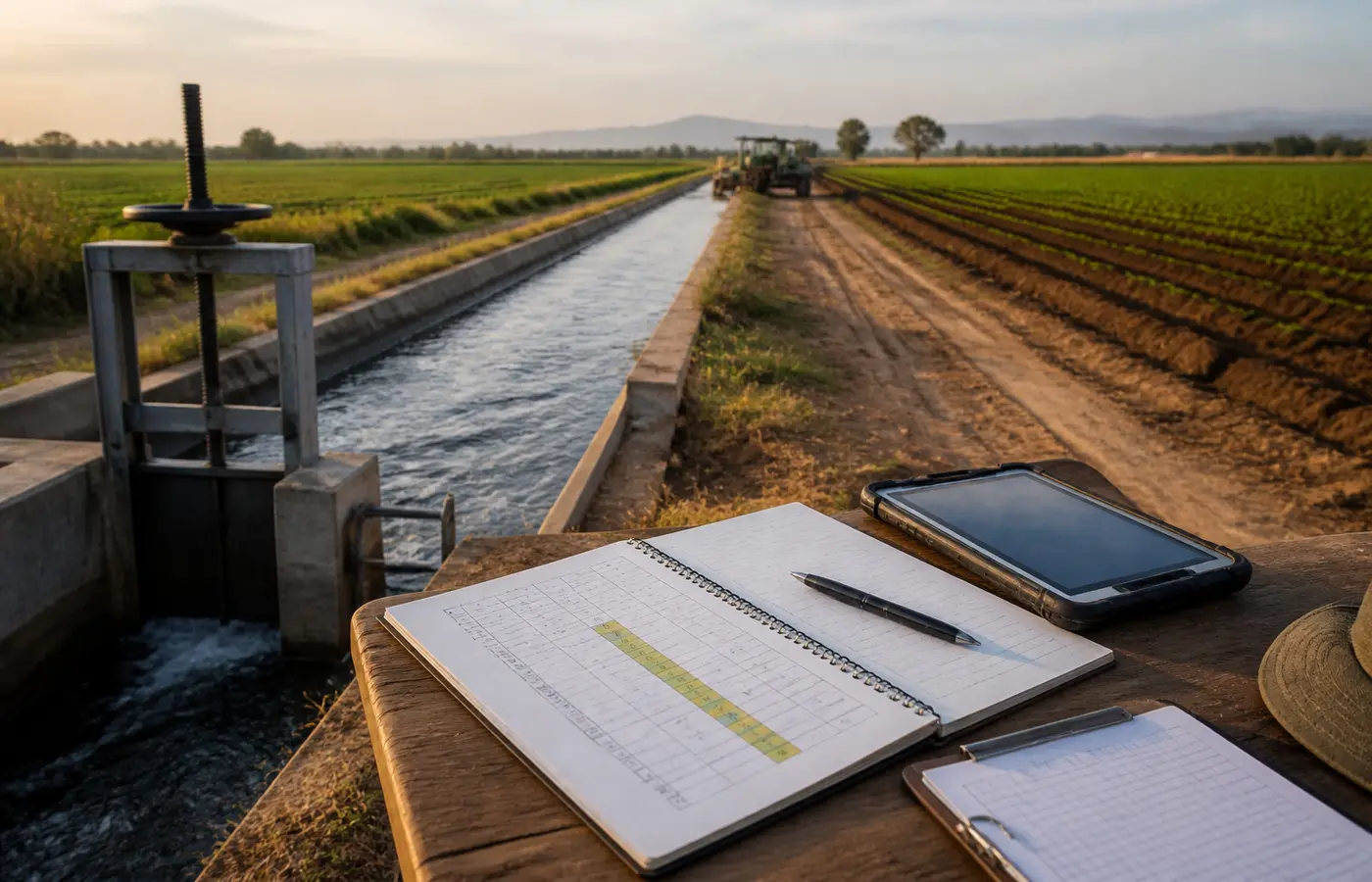
When several fields depend on one water source, the most useful record is not a detailed narrative written at the end of the day. It is a short, consistent turn log that shows what was planned, what actually happened and what the next person needs to know.
The record does not need to prescribe irrigation volumes, field order or crop decisions. Those choices depend on the local water arrangement, field conditions and the team’s own authority. Its purpose is narrower: create a reliable handover trail for each delivery period.
A workable shared-water irrigation record should answer five questions quickly:
- Which source, outlet or delivery point was involved?
- Which field was due to receive water?
- When was the turn planned to start and finish?
- When did delivery actually start and finish, if known?
- Who recorded a change, interruption or follow-up need?
This distinction matters when crews change, fields are served in rotation or water availability changes during a turn. A plan is not evidence that a delivery was completed. A completion note is not a substitute for the original allocation plan.
Set up one turn record for each delivery period
Create one entry for each distinct water turn or delivery period. This may be a scheduled rotation, a shift-based handover or another unit your operation already uses. The important point is consistency: avoid relying only on memory, informal phone messages or a single end-of-day summary.
The entry should identify the water delivery context before it describes the event. At minimum, include the date, source or outlet identifier, field identifier and the name of the person making the entry.
This approach is consistent with the general purpose of irrigation records described in Colorado State University’s Irrigated Field Guide & Record Book, which presents structured records as a management tool. The publication is a US extension resource, not a Chinese operating rule or a required local form. Its useful lesson here is simply that a repeatable table can make irrigation information easier to retrieve and compare.
A delivery period should also be defined in operational terms. Oregon State University Extension distinguishes delivery frequency, rate and duration in its guide, Irrigation water: How it’s delivered, how it’s measured. For a shared-source log, the relevant recordkeeping point is that duration is a separate piece of information: note the time water was expected to be available and the time it was actually available, where your team can observe or confirm it.
Do not turn the log into a catch-all field notebook. If an observation does not affect the turn, its handover or a follow-up task, it may belong elsewhere. A short record that is completed consistently is more useful than an elaborate form that staff abandon during busy periods.
Keep the allocation plan separate from the completed turn
Use two linked parts of the record: the allocation plan and the actual turn entry.
The allocation plan states the intended arrangement. It may include the expected field sequence, planned start and end window, relevant outlet and the person or team expected to manage the turn. It should remain visible even if the day changes.
The completion entry records what was observed or reported during operations. It should state actual start and end times, the recorder, the turn status and any departure from the plan. If the actual end time is not yet known, mark the entry as open rather than filling it with an estimate.
This separation avoids a common handover problem: a planned slot can look like a completed delivery when both are written in the same undifferentiated column. It also allows the next planner to see whether a change was deliberate, unresolved or simply not recorded.
Oregon State University Extension’s irrigation water management planning guide identifies water sources, field locations, delivery schedules and allocation limits as information to collect when preparing a plan. That is planning context, not a universal operating template. ACA’s practical recommendation is to keep that planning information distinct from the field event log because the two records answer different questions.
For example, a plan may show Field B as the next intended turn from 14:00 to 18:00. The completion side may later show an observed start at 14:25, an early stop at 17:10 and a follow-up task for the source-side contact. The original plan should not be overwritten. Keeping both entries lets a later reviewer understand the difference between the intended allocation and the actual event.
Use a field-level turn log that supports handovers
The following is an ACA practical framework, not a required form. Adapt the labels, language and approval fields to the way your farm, cooperative, irrigation group or contractor team works.
| Record item | What to enter | Why it helps at handover |
|---|---|---|
| Date and turn reference | Date plus a simple turn, shift or sequence number | Keeps related entries together without relying on memory |
| Source or outlet identifier | Canal gate, pump line, pipe outlet or locally used identifier | Shows which shared delivery point was involved |
| Field identifier | The farm’s established field name or code | Reduces ambiguity where field names are similar |
| Planned start and end | The intended time window | Preserves the allocation plan |
| Actual start and end | Observed or confirmed times, marked as pending if incomplete | Shows what happened rather than what was intended |
| Recorder | Named person entering the record | Gives the next operator a contact point for clarification |
| Turn status | Completed, ongoing, interrupted, changed or not started | Makes open issues visible quickly |
| Interruption or change | Short factual description | Records the event without assuming its cause |
| Reason as reported | Source-side notice, access issue, equipment observation or other reported explanation | Separates reported information from verified findings |
| Action owner | Named person or role responsible for the next step | Prevents follow-up from being assigned to an unspecified team |
| Follow-up time or sign-off | Review time, confirmation note or open-item deadline | Carries unresolved work into the next handover |
The table records events and responsibilities. It does not tell the team how much water to apply, how long a field should receive water or which field should have priority. Those are separate decisions and may require local instructions, allocation arrangements and crop-specific assessment.
A field-and-time structure also has broad precedents in irrigation recording materials. For example, a National Water Academy irrigation-recording format includes field and date/time elements. That material reflects a different institutional setting, so it should not be copied as governance guidance for a Chinese operation. It nevertheless supports the basic record-design idea that a turn needs both location and time.
Record interruptions and changes as events, not afterthoughts
A late start, early stop or field-order change should have its own brief event note. Do not bury it in a general comment such as “water issue” or “schedule changed.” Write what was noticed, when it was noticed, who was informed and what remains to be done.
Use plain, bounded wording. For example:
- “15:10 — delivery not observed at outlet; source contact informed by [name]; actual start remains open.”
- “16:40 — Field C served before Field B following instruction from [role]; original planned sequence retained in log.”
- “17:25 — turn stopped; reported equipment issue at delivery point; maintenance follow-up assigned to [name or role].”
These notes are intentionally different from a diagnosis. A recorder may observe that delivery stopped or that access was blocked, but should not state a technical cause unless the responsible maintenance or source-management process has verified it.
The Oregon State guide on water delivery notes that availability can fluctuate because of source limitations, allocation schedules or infrastructure. That establishes a useful general reason not to assume that every planned turn will proceed unchanged. It does not establish why a particular interruption occurred on your farm.
Keep the original planned entry visible and add a dated actual-event note. Editing the plan until it matches the outcome may make the page look tidy, but it removes the information needed to understand the change later.
Assign recording responsibility before the turn starts
A log is stronger when it identifies the person who entered it. “Crew” or “irrigation team” may describe who worked, but it does not identify who can clarify an unclear time or explain an open item.
Before the turn begins, agree on three practical points:
- Recorder: Name the person responsible for entering the start, end and event notes.
- Change authority: Identify who can confirm a field-order change, extended turn or other departure from the allocation plan.
- Handover location: State where the current record is kept, such as a paper sheet at the pump station, a shared file or an agreed operations group.
The National Water Academy material on irrigation recording describes appointing a person to record irrigation at an outlet. The administrative arrangements in that material belong to its own water-user association context. ACA’s narrower takeaway is that a named recorder makes the record more usable than an unassigned responsibility.
Local teams should define their own authority and escalation path. Do not import approval structures from overseas materials, and do not treat this record as proof of water rights, allocation compliance or legal responsibility unless the relevant local authority has explicitly defined it that way.
Review the log at the next planning handover
The next planning handover is the right time to compare planned turns with actual entries. This is a record-quality check, not a claim that the log alone can determine the next allocation or crop water requirement.
Review the following before issuing or confirming the next field sequence:
- Entries with no actual start or end time
- Turns marked ongoing, interrupted or changed
- Field-order changes that need confirmation
- Follow-up actions without an owner or completion note
- Differences between the planned window and the actual delivery period
If an item remains unresolved, carry it forward explicitly. For example, write “actual end time to be confirmed at next shift” rather than leaving a blank that later looks like a completed record.
Colorado State University’s recordkeeping guide frames irrigation information as useful for management decisions and for understanding differences among fields. In a shared-water setting, ACA’s practical extension of that principle is modest: review the record while the next handover can still act on missing information. The log will not remove every operational disagreement, but it can make the basis of the handover clearer.
Start with one source, one field group and one week of turns. At the end of that period, ask whether the form identifies the source, field, planned window, actual event, recorder and unresolved action without requiring verbal reconstruction. If not, simplify the form or clarify responsibility before adding more detail.
Frequently asked questions
What is the minimum information to record for a shared irrigation turn?
Record the date, source or outlet, field, planned time window, actual start and end where known, named recorder and turn status. Add a short note and action owner when the turn changes or is interrupted.
Why should planned irrigation turns be kept separate from actual completion times?
The plan shows what was intended; the completion entry shows what occurred. Keeping them separate prevents a proposed allocation from being mistaken for completed delivery and preserves a clearer trail when timing or field order changes.
Who should sign or enter a shared-water irrigation record?
Name one recorder for each turn or shift. Your operation should also identify who can confirm changes and where the current log is stored. The right authority structure depends on the local team and water-management arrangement.
How should a team record an interrupted irrigation turn?
Keep the planned entry intact. Add the time the interruption was noticed, a factual description, any reason as reported, the person informed and the owner of the next action. Do not state an unverified technical cause as fact.
Source and further reading
ACA’s practical examples and working checklists are independent editorial analysis. The linked source provides the underlying reference; it does not endorse this article.